
Why automation exists: the work decays faster than humans repeat it
Amazon PPC is not hard the way chess is hard — most individual decisions are threshold checks. It's hard the way brushing your teeth 400 times a day would be hard: the same small evidence-based actions, across every target, every campaign, forever. Search terms leak in daily; conversion rates drift with seasons and competitors; a bid sized correctly in September is wrong by November.
Humans handle this with weekly routines — and the routines decay the week life intervenes. The measurable result shows up in our live benchmarks: about one ad dollar in nine sitting on search terms that had already proven they don't convert. Nobody decided to spend that; it's what un-repeated maintenance looks like in money. Automation, at its honest core, is just the maintenance loop made incapable of skipping a week.
The four levels of "automation"
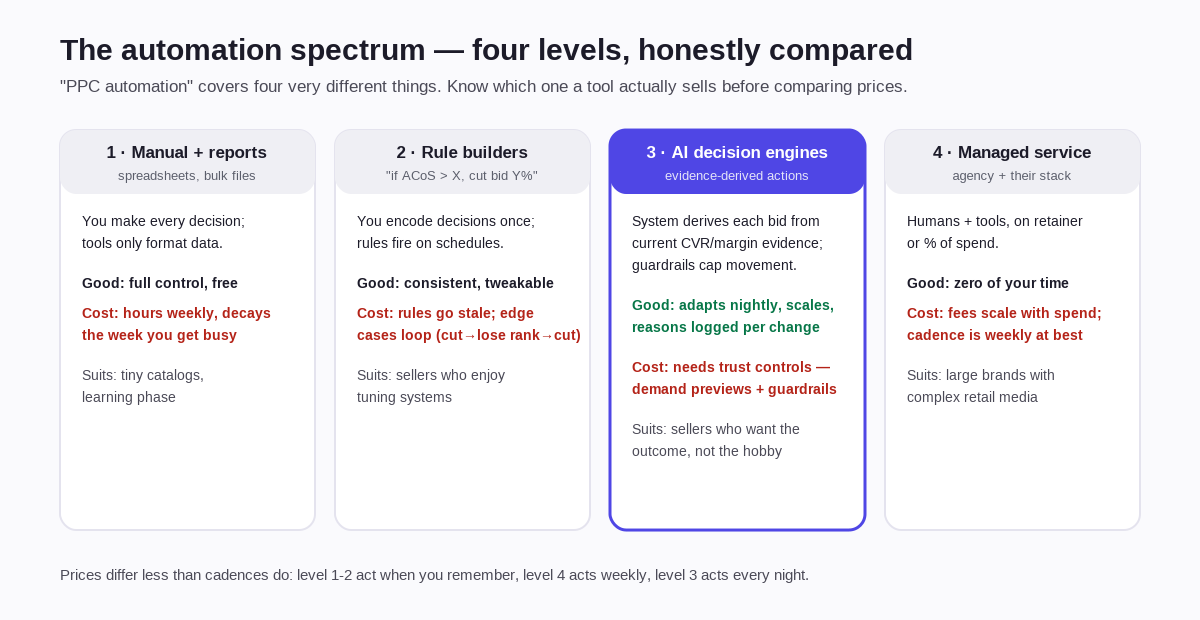
The level that fits you depends on an honest question: do you want a hobby or an outcome? Rule builders (level 2) reward sellers who genuinely enjoy tuning systems — and punish everyone else when rules go stale. The classic stale-rule failure is the death spiral: "if ACoS > 35%, cut bid 10%" fires, position falls, sales fall, rank decays, ACoS rises on lower volume, the rule fires again. A static rule can't see that it's the cause. Level 3 engines re-derive decisions from current evidence instead of frozen conditions — which is also what makes them harder to evaluate from the outside, hence the test below.
Level 4 (agencies) is a different economic object: you're buying human attention, typically weekly, priced as a retainer or a share of spend. Whether that trade makes sense at your scale is its own question — the agency-alternative page works the math both ways.
What a nightly cycle actually does
Concretely — using AIAdKing's cycle as the worked example, since it's the one we can describe truthfully from the inside:
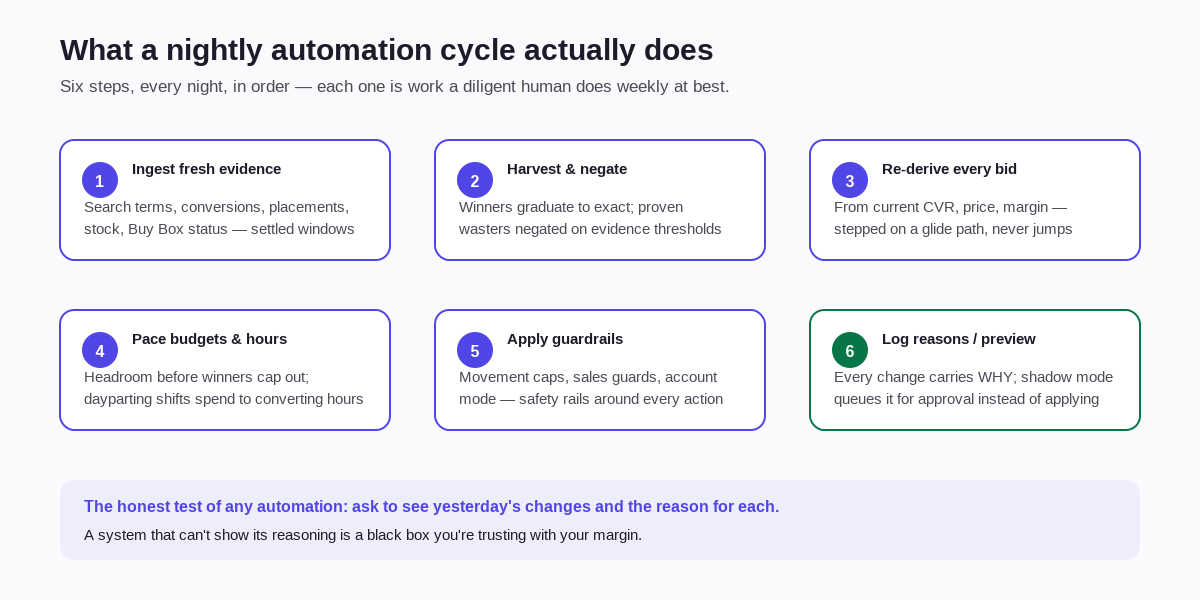
Three design choices in that loop matter more than any feature list:
- Settled windows, not raw yesterdays. Amazon attributes orders to clicks for days; a system reacting to day-old ACoS reacts to noise and will always look "decisive" while being wrong. Evidence windows must exclude unsettled days.
- Glide paths, not jumps. Bids step gradually with a sales guard — the same glide-path discipline a careful human would use, because auction position and rank punish cliff changes regardless of who makes them.
- Reasons attached to every change. Not for decoration — because reasons are what make an automated account auditable. You should be able to open any bid and read why it is what it is.
The risks nobody puts on the pricing page
Honest automation talk includes the failure modes:
- Black-box drift. A system that won't show per-change reasoning can be quietly wrong for months. This is the single biggest thing to test before trusting anything with your margin.
- Bad-data amplification. Automation multiplies whatever it reads. Wrong margins entered → confidently wrong break-evens; a mispriced variation → bids tuned to a listing that can't convert. Garbage in, faster garbage out.
- Event-week literalism. Rules and models trained on normal weeks can misread event dynamics — treating a Prime-event CPC spike as a trend to flee, or an event conversion surge as a new baseline to bid into. Good systems carry event awareness; ask.
- Control anxiety, solved badly. Some tools answer "can I trust it?" with an approval queue for everything — which recreates the manual workload with extra steps. The workable pattern is graduated trust: preview everything at first (shadow mode), then let evidence earn autonomy, with guardrails capping how far any single change can move regardless.
The 20-minute evaluation for any tool
Run this against any automation you're considering — including ours:
- "Show me yesterday's changes and the reason for each." If the answer is a dashboard of outcomes rather than a log of decisions, you're buying a black box.
- "What happens in my first week?" The right answer involves a preview period on your real account — proposed changes you can read before anything applies. Wrong answers involve immediate bulk changes to a live account.
- "How do bids handle attribution lag?" Listen for settled windows. A tool bragging about reacting "in real time" to conversion data is bragging about reacting to noise.
- "What are the movement caps?" Every serious system bounds how far a bid or budget can move per cycle. No caps, no trust.
- "What does it cost at 3× my spend?" Percentage-of-spend pricing means the tool's revenue grows with your costs — a misaligned incentive worth pricing in. (AIAdKing charges a flat fee for exactly this reason; the tools roundup compares pricing models across the market.)
- "What does it do beyond bids?" Negation, harvesting, budgets, hour-of-day, placements — bid-only tools automate a third of the job and leave the leak-prone rest to you.
What automation can't do (and shouldn't pretend to)
Boundaries, stated plainly:
- It can't fix a listing. If clicks don't convert because of price, images or reviews, automation will correctly conclude the traffic isn't worth much — and optimise you into a small, efficient corner. The sales-side diseases need product work, not bid work (tools can flag them; humans fix them).
- It can't choose your strategy. Launch aggressively above break-even or harvest profit conservatively? Defend brand terms or not? Those are business calls with trade-offs a system should execute faithfully, not make for you.
- It can't conjure demand. Automation optimises the demand that exists. A product nobody searches for needs marketing, not bid management.
A tool that claims otherwise is selling; one that names its boundaries is probably also honest about the parts it does own.
The build-it-yourself middle path (and where it tops out)
Between manual work and buying a tool sits a path many technical sellers try: bulk files and spreadsheets as home-made automation. It deserves an honest appraisal because it genuinely works — up to a ceiling.
The workable version: download the bulk operations file weekly, run your logic in spreadsheet formulas (flag wasters at your click threshold, compute bid targets from conversion rates and margins), review the flagged rows, upload the changes. This is real automation of the analysis, with a human hand still on the apply step — a decent trade for a small catalog, and the best possible way to learn what the decisions actually are before delegating them.
Where it tops out, in practice:
- Cadence. The loop runs when you run it. The week you skip is the week a broad target starts leaking — and skipped weeks are precisely how the common mistakes compound.
- Granularity. Hour-of-day bidding, per-placement modifiers and event-week pacing are miserable in bulk files. Most spreadsheet operations quietly ignore them — leaving the levers that separate good from great untouched.
- State. A spreadsheet doesn't remember why last month's bid was set, whether a step's sales guard fired, or which negation was provisional. You become the database, and human memory is the least reliable component in the stack.
A reasonable rule: if the weekly loop takes under an hour and actually happens every week, the spreadsheet path is fine. The month it stops happening — catalog growth, a busy season, life — is the honest signal to move up a level, with the evaluation questions above in hand.
Getting started without betting the account
The low-risk adoption path, whatever tool you choose: connect through official APIs only (never share Seller Central credentials — see how connection should work), run the first weeks in preview mode reading every proposed change and its reason, then graduate autonomy as the reasoning earns it — guardrails on throughout. With AIAdKing that path is the default: shadow mode from day one, nightly cycles you can audit line by line, and a free trial with no card so the evaluation above costs you twenty minutes and nothing else — start here.