
How to use this list: rank by cost, not by guilt
Every "PPC mistakes" list treats its items as equally important. They aren't. A mis-set placement modifier costs you a few points of efficiency; a proven waste term left un-negated for a quarter costs real money every single day. The matrix below is how we'd triage — the top-right quadrant (expensive and present in almost every account) is where your first hour goes.
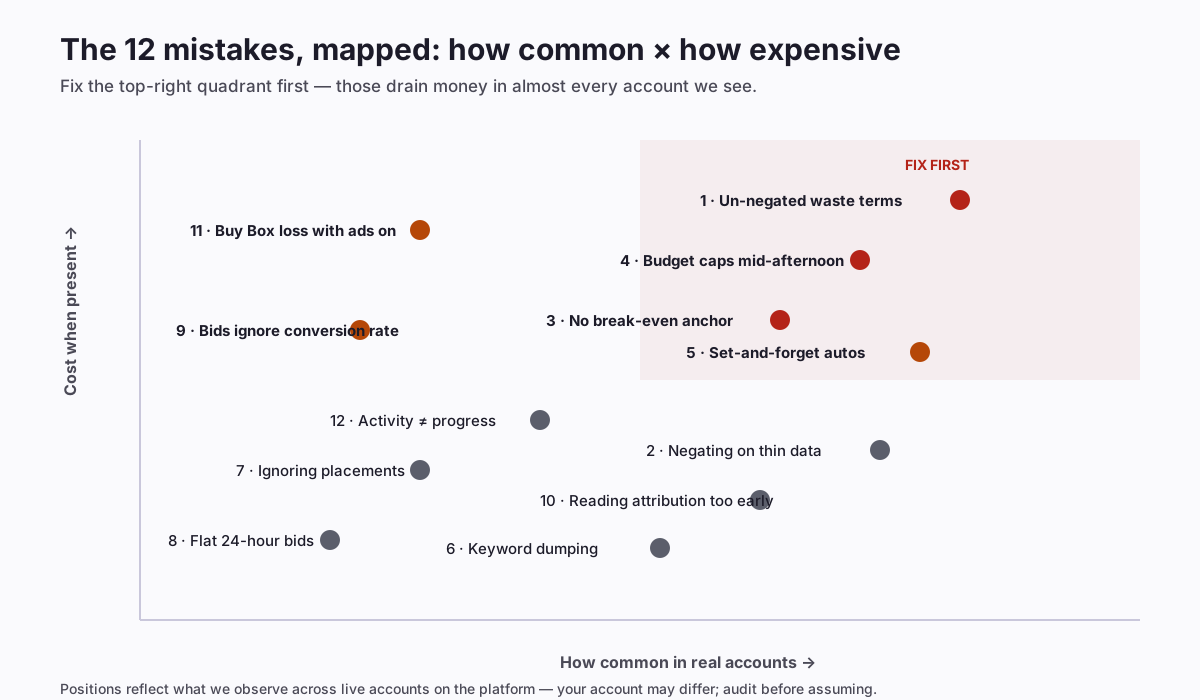
One number worth knowing before you start: in our live seller benchmarks, about 10.8% of the last 30 days' search-term spend sat on terms with 15+ clicks and zero orders — enough evidence to call them wasters. That is the size of the prize for mistake #1 alone.
Mistakes 1–3: the money bleeders
1 · Letting proven waste terms keep spending. The search-term report tells you, in plain numbers, which queries have taken meaningful clicks and never converted. Leaving them active is the single most expensive habit in Amazon PPC because it compounds daily. The fix is a weekly negation pass — the negative keywords guide walks the whole method, and the keyword-bleeding-money triage covers the single-worst-offender case.
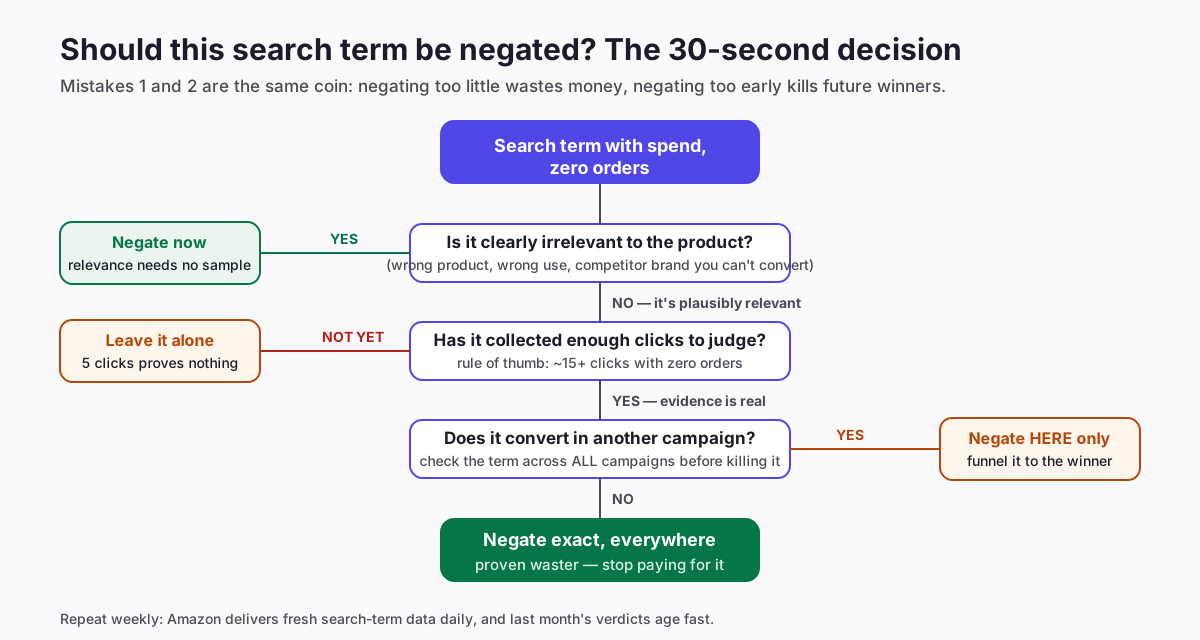
2 · Negating on thin data. The opposite failure: a term with four clicks and no orders gets negated in a fit of tidiness, and with it dies a future winner — most converting terms looked "unproven" in their first week. Relevance problems can be negated on sight; performance problems need a real sample first:
3 · Running ads with no break-even anchor. If you can't say what ACoS turns a sale unprofitable for each product, you can't evaluate any campaign decision — a 40% ACoS is excellent for one margin structure and ruinous for another. Two minutes on the break-even ACoS calculator gives every product a number; the lower-ACoS guide shows how to steer toward it without strangling sales.
Mistakes 4–6: the delivery killers
4 · Budget caps that switch winners off at 2pm. A campaign that profitably spends its daily budget by early afternoon isn't "done" — it's dark for the hours when many categories convert best, and Amazon's delivery diagnostics won't shout about it. If a campaign hits its cap most days at a healthy ACoS, the cap is the mistake, not the spend.
5 · Set-and-forget auto campaigns. Auto campaigns are discovery engines: they exist to find converting search terms you then graduate to exact-match control. Left unharvested, they quietly become your most expensive campaign type — paying discovery-level CPCs forever for terms you should own precisely. Harvest monthly at minimum; weekly is better.
6 · Keyword dumping. Fifty keywords in one ad group with one bid means the strong terms subsidise the weak ones and the search-term report becomes soup. Structure follows intent: tight ad groups around close keyword families, exact-match winners in their own campaigns where their budget is protected. (Our how-to-advertise guide covers structure from scratch.)
Mistakes 7–9: the precision losses
7 · Ignoring placement data. The same keyword can perform completely differently at top-of-search versus product pages — same bid, different world. The placement report tells you where conversions actually happen; placement modifiers let you pay up only where it's earned. Most sellers never open that report.
8 · One bid for all 24 hours. Conversion rates move by hour of day — browse-heavy midnight clicks and buying-intent evening clicks cost you the same flat bid unless you daypart. Manual dayparting is tedious enough that almost nobody sustains it, which is why we built hour-aware bidding into the nightly cycle.
9 · Bids that ignore conversion rate. The bid a keyword deserves is a function of its price, margin and real conversion rate — not of what a competitor seems to pay or what feels aggressive. A keyword converting at 5% supports roughly half the bid of one converting at 10%, and "bid up because impressions fell" without that arithmetic is how ACoS climbs quarter after quarter. The ACoS and calculator pages cover the arithmetic if you want to run it by hand.
Mistakes 10–12: the judgment errors
10 · Reading attribution too early. Amazon attributes orders to clicks for days after the click — yesterday's ACoS is always overstated, and a report pulled the morning after a change "proves" whatever you feared. Judge changes on a 7-day-settled window, not a 24-hour snapshot. (This is also why event weeks need a second look — see the Prime Big Deal Days playbook on the two-pass harvest.)
11 · Running ads while losing the Buy Box. Sponsored Products serve only while you hold the Buy Box. A repricer war, a pricing error, or a suppressed offer silently stops your ads — impressions flatline and nothing in the ads console says why. In our Buy Box loss data, sellers were not holding the box in a meaningful share of hourly checks — each one an hour of ads that couldn't serve.
12 · Confusing activity with progress. Logging in daily and nudging bids feels like management, but unmeasured tweaks are noise — and paying an agency retainer for the same busywork is the expensive version of the same mistake. Every change should have a reason attached and a date you'll judge it by. If you can't reconstruct why a bid is what it is, the system is running you. (Deciding between doing this yourself, an agency, or software is its own question — the agency-alternative page lays out the trade-offs honestly.)
How the mistakes compound: one product, one bad quarter
These twelve rarely appear alone — they feed each other, and the combination is what turns a profitable product into a "PPC doesn't work for us" story. A composite example we see constantly, assembled from real account patterns:
A seller launches a kitchen product with a single auto campaign and a generous budget (reasonable start). It finds converting search terms in week two — but nobody harvests them (mistake 5), so the campaign keeps paying discovery CPCs for terms that deserved exact-match bids. Spend grows, so the seller trims the daily budget instead of the waste; now the campaign caps out by 1pm (mistake 4) and misses the evening conversion window entirely. ACoS drifts up. Without a break-even anchor (mistake 3) the seller can't tell whether 38% is a crisis or normal for launch, panics, and cuts bids across the board — including on the three terms producing most of the orders (mistake 9). Sales fall, which loosens the product's grip on organic rank. A week later, judging the "experiment" on two days of unsettled attribution (mistake 10), the seller concludes the bid cut "didn't help either" and pauses the campaign.
Every individual decision felt sensible in the moment. The account-level result: a product with genuine demand, shelved. Unwinding it isn't heroic — it's the ranked list above, applied top-down: negate the waste, harvest the winners, set the anchor, un-cap the profitable campaign, and judge each change on a settled window.
The auto-campaign harvest, step by step
Because mistakes 1, 5 and 6 all resolve through the same workflow, here it is end to end — this is the single procedure that pays for the time it takes, every time:
- Pull the Sponsored Products search-term report for the last 30-60 days (Ads console → Measurement & Reporting → Sponsored ads reports). Sixty days smooths out weekly noise; thirty reacts faster after big changes.
- Sort by spend, descending. The top twenty rows usually hold most of the money — both the wasters and the winners.
- Mark the wasters: meaningful clicks (rule of thumb ~15+), zero orders, plausibly relevant. Add each as negative exact in the campaign that spent on it — negative phrase only when a whole family of variations is junk, because phrase negation is a blunt instrument that can block future winners.
- Mark the winners: terms with orders and an ACoS inside your break-even. Create or extend an exact-match campaign for them, with their own bids sized to each term's conversion rate and their own protected budget. Then negative-exact those terms in the auto campaign — otherwise the auto keeps competing against your own exact campaign and inflates both CPCs.
- Leave the middle alone. Terms with a few clicks and no verdict yet are tomorrow's data. Touching them now is mistake 2.
- Diarise the repeat. Amazon delivers fresh search-term data daily; the report you actioned today starts aging immediately. Weekly is the cadence that keeps the waste share near zero — and it's exactly the loop the ads-automation guide shows how to hand off entirely.
The 15-minute weekly self-audit
You don't need to fix all twelve at once. This weekly routine catches the expensive ones before they compound:
- Search-term report, sorted by spend — negate proven wasters (mistake 1), graduate proven winners out of autos (mistake 5). ~6 minutes.
- Budget-cap check — which campaigns hit their cap yesterday, and at what ACoS? Raise the profitable ones (mistake 4). ~2 minutes.
- ACoS vs break-even per product — one glance against your anchors (mistake 3), on a 7-day-settled window (mistake 10). ~3 minutes.
- Buy Box + listing spot-check on your top sellers (mistake 11). ~2 minutes.
- One structural improvement — a placement modifier reviewed, an ad group split, a dayparting look (mistakes 6-8). ~2 minutes.
Fifteen focused minutes weekly beats an anxious hour daily — because it's measurable, repeatable and hits the ranked list top-down.
Fixing this permanently
Every mistake above shares a root cause: this work is repetitive, evidence-based and endless — exactly the profile humans are worst at sustaining and software is best at. Amazon PPC automation exists to run the weekly routine nightly: AIAdKing harvests and negates on real evidence thresholds, paces budgets, matches bids to conversion rates hour by hour, and logs a reason for every change — with shadow mode showing you each proposed action before it touches your account. Flat monthly fee, no percentage of your spend, so fixing mistake 1 doesn't create mistake 13.