
What an agency actually sells: the bundle, unbundled
Strip the pitch decks and an Amazon ads agency sells three distinct things:
- Execution: the recurring operational loop — report reading, negation, graduations, bid maintenance, budget pacing. Typically performed weekly-ish, by an account manager carrying many accounts.
- Strategy: judgment work — launch architecture, format mix, DSP and off-Amazon planning, creative direction, category positioning. The scarce, genuinely human part.
- Accountability: someone to present the numbers, own the misses, and answer the CEO's questions. Real organisational value — and worth naming as a separate line item, because it's often the part actually being purchased.
The bundle's pricing problem: fees (10-15% of spend, or $1,000-2,500+ retainers) scale with spend, while the bundle's value scales with completely different things — execution value with account messiness, strategy value with business complexity, accountability value with org size. The mismatch is where most disappointment is born, in both directions.
The displaced-cost math
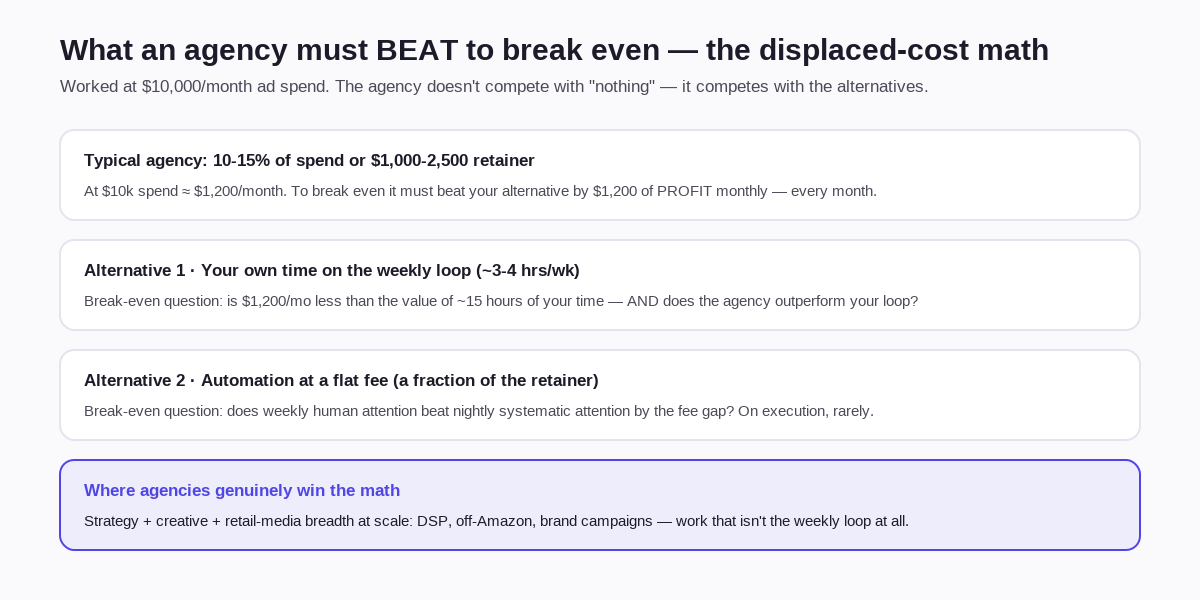
The frame matters: an agency never competes with "nothing" — it competes with your best alternative. For the execution slice, the alternatives are your own 3-4 weekly hours running the loop, or flat-fee automation running it nightly. For an agency's execution to be worth $1,200/month, weekly human attention must outperform those by $1,200 of monthly profit — a bar that cadence alone makes steep: a Tuesday-review agency reads your account 4 times a month; the search-term leaks and budget cap-outs between reviews belong to nobody.
For the strategy slice the math inverts: a launch architecture that works, a DSP program that opens a channel, creative that lifts CVR — these are step-changes worth many retainers, if your business has those problems. The unbundled question, always: which slice am I paying for, and is that slice my constraint?
Who genuinely benefits (the honest yes-cases)
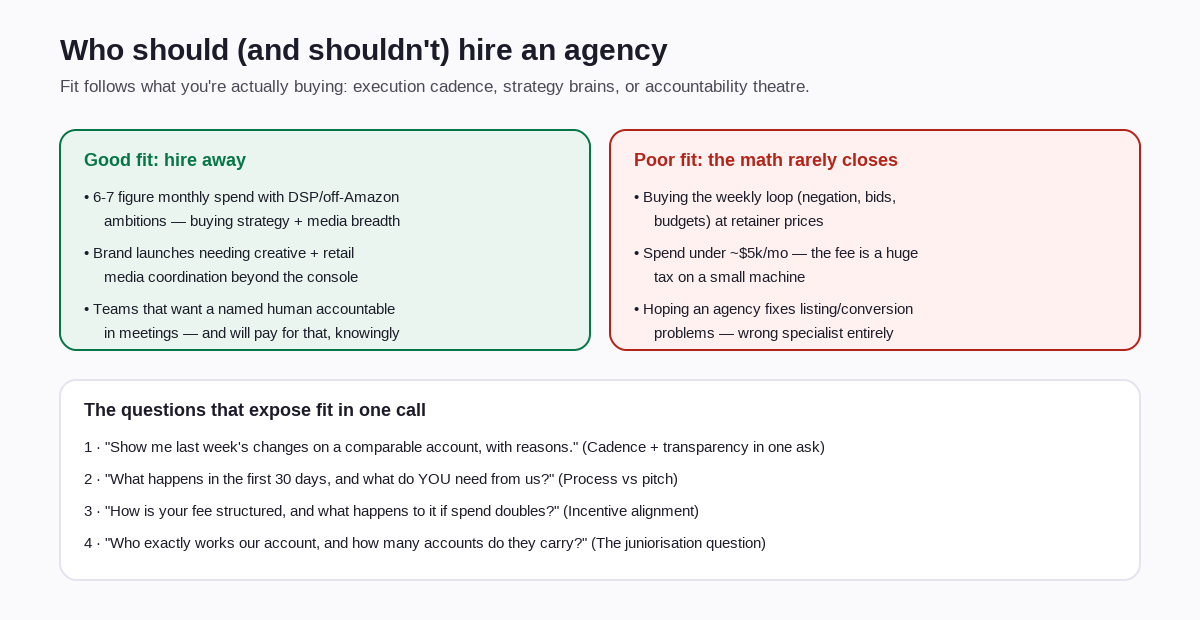
Expanding the good-fit column, because this guide means it:
- Scale with breadth: at six-to-seven-figure monthly spend spanning DSP, off-Amazon and retail media, you're buying a media-buying operation you shouldn't build in-house yet. This is the agency home turf, and good ones earn their fees there.
- Launch-heavy brands: serial launches need creative production, positioning judgment and coordinated pushes — strategy-slice work where experienced humans compound.
- Teams buying accountability knowingly: if a named external owner of the ads number is worth the fee to your organisation — a real answer for funded brands — buy it with open eyes and hold the cadence questions below anyway.
- The bridge case: a seller with no time, no systems and a messy account can rationally hire an agency as a bridge — clean-up plus knowledge transfer on an explicit exit timeline. The failure mode is the bridge becoming a permanent toll.
The failure patterns (why the reviews are so bitter)
Agency horror stories cluster into four repeatable shapes:
- Juniorisation: sold by the founder, serviced by a junior carrying 25 accounts. Your account gets a template and a monthly report. Question 4 in the matrix exists for this.
- The incentive wedge: percentage-of-spend fees reward spend growth, not profit growth — "scaling" your budget grows their invoice whether or not it grows your margin. Not malice, just gravity; flat-fee agencies exist partly to remove it.
- Cadence theatre: weekly attention marketed as management, while the account leaks daily between touches. The tell is in their own reporting: if the monthly deck shows outcomes but can't show changes with reasons, the loop isn't actually running.
- Wrong-specialist assignments: agencies hired to fix what are really listing-conversion or economics problems — symptoms C and D wearing an ads costume. Months of fees later, the listing is still the patient.
None of these are arguments against agencies; they're arguments for the interrogation below, and for never buying the bundle without naming which slice you need.
The one-call interrogation
Four questions (bottom of the matrix above) expose more than any case study page:
- "Show me last week's changes on a comparable account, with the reason for each." The single best filter. A real operation produces a change log instantly; a theatre operation produces a deck about "holistic optimisation". (Hold your tools to the same standard — the automation evaluation uses the identical question.)
- "What happens in the first 30 days, and what do you need from us?" Listen for an audit process, margin/break-even collection (they can't bid correctly without it), and honest data requests — versus instant-results promises.
- "How does your fee move if spend doubles?" Names the incentive wedge out loud. The answer isn't disqualifying either way; the discomfort answering it is.
- "Who works the account, and how many accounts do they carry?" Juniorisation, quantified. Fifteen-plus accounts per manager is a template business, whatever the pitch said.
Add a fifth for renewals: "What did we learn last quarter that changed what you do?" An account run on evidence accumulates lessons; an account run on template accumulates months.
The middle path most sellers actually land on
Unbundling suggests a division of labour that's become the pragmatic default:
- Execution → systems. The weekly loop is threshold-checking against fresh data — cadence work where nightly automation structurally beats weekly humans at a fraction of retainer cost, with every change logged (the transparency the interrogation demands, produced mechanically).
- Strategy → bought by the hour, when needed. A launch consult, a quarterly strategy review, a DSP scoping call — the genuinely human slice, purchased as expertise rather than bundled into perpetual retainers. Often from the same good agencies, who increasingly sell it this way.
- Accountability → the dashboard plus a monthly hour. For most owner-operated brands, a written decision log and honest TACoS trend answer the accountability need the meeting-human was proxying for.
The math of the middle path at $10k spend: automation's flat fee plus occasional hourly strategy typically lands under a third of the bundled retainer — with daily cadence instead of weekly. The cases where it's wrong are exactly the good-fit column above: breadth, launches, org-level accountability. (Our agency-alternative page works this comparison in detail, with the caveats kept in.)
If you hire: running the relationship well
For readers landing on "yes, agency" — the practices that separate good engagements from bitter reviews:
- Contract the change log. Weekly delivery of changes-with-reasons, in writing, as a deliverable — not the monthly outcome deck. What gets logged gets done.
- Keep the credentials architecture clean: agency access via Amazon's proper user-permission and API grants (how connection should work), never shared passwords — and revocable in a click when the engagement ends.
- Own your data exhaust: break-evens, search-term learnings, launch results live in your documents. Agencies leave; the account's accumulated evidence shouldn't leave with them.
- Review on displacement, not decks: the quarterly question is what blended results did the fee move — same displacement discipline as any spend.
- Pre-agree the exit: handover format, notice period, and what "done" looks like. Bridges need far ends.
The decision, compressed
The whole guide in four lines:
- Buying execution? The math rarely closes against nightly systems at flat fees — cadence is structural, not motivational.
- Buying strategy? Buy it by the hour from proven humans, or bundled if your spend and breadth put you on agency home turf.
- Buying accountability? Legitimate — price it knowingly, and still demand the change log.
- Not sure which you're buying? That's the tell you're about to buy the bundle by default. Run the interrogation, name the slice, then decide.
And whichever way it lands: the account's foundation — clean loop, formula bids, settled-window judgment — is non-negotiable under every management model. AIAdKing exists for the execution slice: the loop run nightly, every action logged with its reason, previewable before it applies, at a flat fee that doesn't grow with your spend. The free trial beside your current setup — agency, manual, or mess — is the cheapest version of this entire decision.