
The principle: not all ad dollars buy the same thing
An ads budget is not a homogeneous pool. Inside it live four very different kinds of dollars: dollars buying nothing (proven-waster clicks), dollars overpaying for something (bids above what conversion rates support), dollars buying thin margins (spend hovering at break-even), and dollars buying your best profitable orders plus the sales velocity that feeds organic rank.
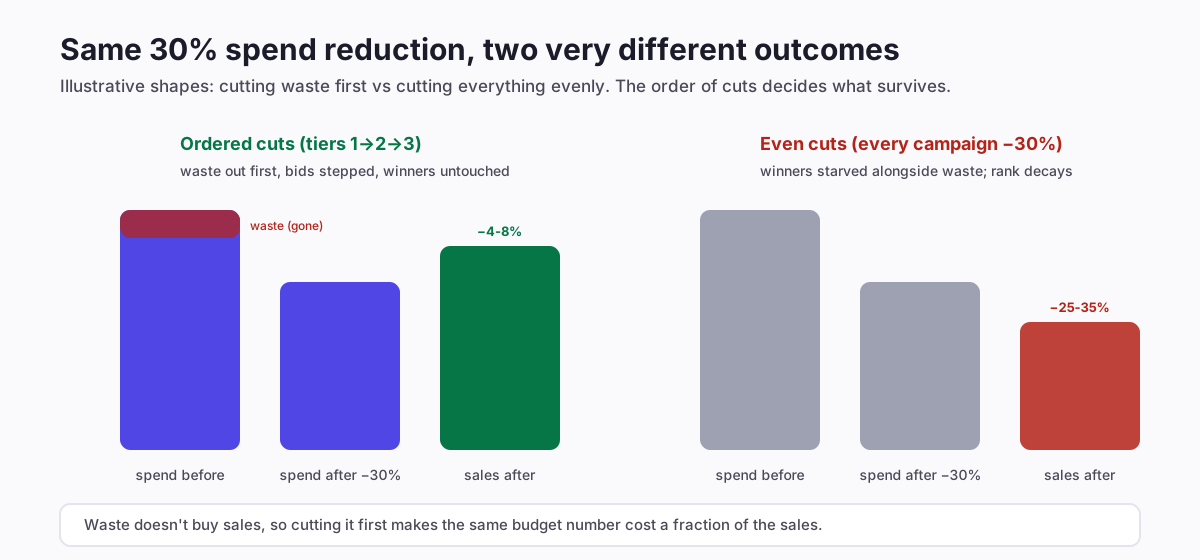
A budget cut is just a choice about which of those dollars leave. Cut in the right order and the first tiers absorb most of the target painlessly; cut evenly — the natural move under pressure, "trim everything 30%" — and you starve winners to keep paying wasters.
The four-tier cutting order
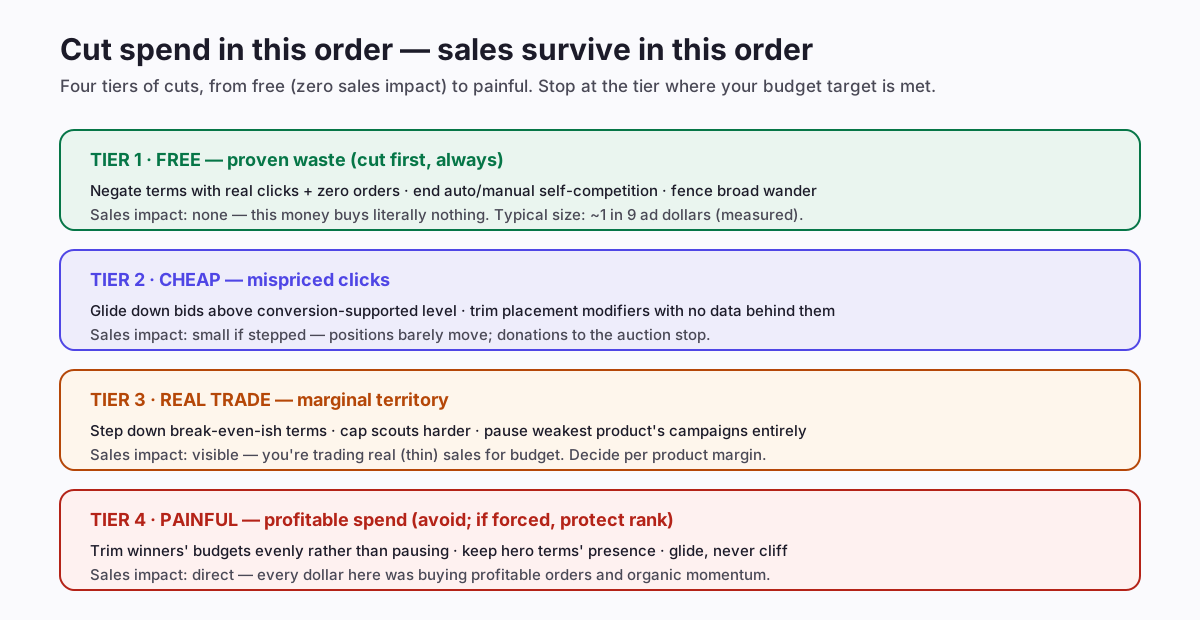
Work down the tiers and stop when the budget target is met. Most real-world cuts of 20-35% are fully absorbed by tiers 1 and 2 — which is the quietly radical claim of this guide: the average account can hit a meaningful budget target without touching a single dollar that was buying real sales. In measured live accounts, roughly one ad dollar in nine sat on already-proven wasters — tier 1 alone, before a single bid moves.
The tiers also imply a diagnostic: if your account needs tier 3-4 cuts to reach a 25% reduction, the account was already unusually clean — or the audit that fed tiers 1-2 wasn't honest. Both are worth knowing.
Tier 1 mechanics: the free money
Everything in tier 1 removes spend with zero sales attached:
- Proven-waster negation. The search term report, 60 days, sorted by spend: every plausibly-relevant term with real clicks (rule of thumb 15+) and zero orders becomes negative exact. Respect the thin-data rule — under-sampled terms aren't wasters yet, and negating them cuts future sales, which defeats the whole exercise.
- Self-competition removal. Graduated terms never sealed in their source campaigns have you bidding against yourself; the seal is a pure price cut on traffic you keep.
- Broad-wander fencing. Broad targets leaking into adjacent-but-wrong queries get negated fences or a match-type tightening — spend falls, relevant traffic doesn't.
- Zombie sweep. Forgotten campaigns — old tests, expired event campaigns, paused-in-spirit-but-active-in-fact experiments — get actually paused.
Do tier 1 completely before touching anything else, even if it overshoots your target: its savings are permanent efficiency, not sacrifice.
Tier 2 mechanics: stop overpaying
Tier 2 dollars bought real things at wrong prices:
- Bids above conversion-supported levels come down the glide path — ~5% steps on settled weeks, sales guard on. Under budget pressure the temptation is to cliff-cut; resist it precisely because you're cutting elsewhere too, and stacked shocks are how accounts spiral. The glide is slower and keeps the positions that matter.
- Placement modifiers without data behind them — a legacy 40% top-of-search boost nobody can justify from the placement report — get stepped down. Modifiers multiply every bid; unjustified ones multiply every mistake.
- Scout budgets ride down naturally: discovery (auto + broad) is a % of spend you choose. In lean times, 10-15% scout share can drop toward 5-8% — discovery slows, ownership continues. Never to zero: an account that stops discovering starts decaying, just on a delay.
Tier 3: the honest trade-offs
If tiers 1-2 didn't reach the target, the remaining cuts trade real (thin) sales for budget — so they're made per-product, by margin, not per-campaign by vibes:
- Rank products by contribution: settled ad-attributed profit (orders × margin − spend) per product. The true-profit view matters here — dashboard revenue flatters products whose fees and returns eat the margin.
- Cut from the bottom: the weakest contributors' campaigns pause entirely. A clean pause of one marginal product preserves more total value than a 40% haircut across six products — concentration beats dilution in both directions.
- Step break-even hoverers down — terms living at 95-105% of break-even are barely-profitable volume; in lean times they're the correct sacrifice, stepped (not slashed) so they can be stepped back later.
- Write down what you cut and why. Tier 3 cuts are meant to be reversed when the constraint lifts; an undocumented cut becomes a permanent forgetting.
Tier 4: if you must cut profitable spend
Sometimes the target is brutal enough to reach your winners. Rules for minimum damage:
- Trim budgets, don't pause campaigns. A paused winner loses delivery history, auction standing and rank momentum; a trimmed one keeps presence at lower volume. Pausing is for products, trimming is for winners.
- Protect the hero terms' floor. Your top terms' visibility feeds organic position — going dark on them starts a rank decay whose rebuild cost usually exceeds the "saved" budget. Keep them present even if diminished.
- Time cuts against the calendar. Cutting into Q4's cheap-December window or right before your category's season maximises regret. If timing is yours to choose, cut into your demand trough.
- Watch TACoS through the cut. If TACoS holds while ad spend falls, organic is absorbing the load — the cut is being subsidised by momentum. When TACoS starts rising on falling spend, you've hit the muscle; that's the floor.
The rebuild: cuts are round trips
Budget cuts end. The account that documented its cuts un-cuts intelligently:
- Restore in reverse tier order: tier 4 winners' budgets first (they re-earn immediately), then tier 3 break-even steps and paused products (re-judged against current data — some deserved the pause permanently), and scouts back to full share last.
- Re-verify before re-spending: a product paused for a quarter re-enters with stale bids and possibly changed competition — its first two weeks back are a mini-launch, not a resume.
- Keep tiers 1-2 forever. The waste you negated and the overpricing you corrected were never "cuts" — they were the account's permanent new baseline. The most common rebuild error is un-learning them by relaxing negation vigilance when money loosens.
A well-run cut cycle often ends somewhere unexpected: the account returns to its old sales level at 80-85% of its old spend, because the pressure forced the efficiency work prosperity kept postponing.
Worked example: a 30% cut on a real-shaped account
An account spending $4,000/month needs to reach $2,800. The tiers, applied:
Tier 1 audit finds: $430/month on proven wasters across the search-term reports, $180 of estimated self-competition (four graduated terms never sealed), and two zombie campaigns from a spring test still sipping $90. Total: $700 — 58% of the target, zero sales risk. One evening's work.
Tier 2 finds: six of the top twenty targets bid 25-45% above their conversion-supported levels (launch bids never walked back), and a legacy 35% top-of-search modifier on a campaign whose placement report shows ordinary top-of-search conversion. Glide steps begin; over five settled weeks these shed roughly $350/month while orders hold within a few percent. Running total: $1,050 — $150 short.
Tier 3 decides the remainder: the product ranking puts a marginal accessory (thin margin, ACoS hovering at break-even, 4% of account orders) at the bottom — its campaigns pause cleanly for the last $160. Documented for restoration; its hero sibling's budget is untouched.
Net result: target met, total orders down ~5%, and — the part worth writing down — the account's blended ACoS improved through a budget cut, because what left was disproportionately waste. Tier 4 never got touched. Most accounts' cuts look like this when the order is respected, and like the right-hand chart above when it isn't.
Keeping spend honest without the emergency
The uncomfortable observation inside every budget-cut story: tiers 1 and 2 were available all along — the emergency just supplied the attention. AIAdKing's nightly cycle is, in effect, tiers 1-2 running permanently: proven waste negated on thresholds every night, bids held at conversion-supported levels continuously, scouts fenced, modifiers evidence-bound — so the account is always already at the efficient frontier, and a future budget target becomes a strategy conversation instead of a triage weekend. Every action logged with its reason, previewable in shadow mode, at a flat fee that — fittingly for this article — doesn't grow when your spend does.