
What backend keywords actually do (and don't)
The generic-keywords field feeds Amazon's search index with terms you want to be discoverable for but don't want in customer-visible text. Indexed backend words make your listing eligible to appear for those searches — organically, and as targets for auto campaigns, which read the same relevance signals.
Equally important is what the field does not do:
- It doesn't rank you. Indexing is eligibility; rank comes from performance — clicks, conversions, sales velocity. A backend word gets you into the race, not onto the podium.
- It doesn't outweigh visible content. Title and bullets carry more indexing weight; the backend is for what they can't gracefully contain.
- It doesn't need repetition. A word indexed once is indexed. Repeating "bottle" five times across fields buys nothing — and singular/plural variants are handled automatically, so one form suffices.
The field, in short, is a coverage instrument: its job is the searches your visible copy legitimately can't serve. That framing decides everything about what belongs in it.
What earns its bytes — and what wastes them
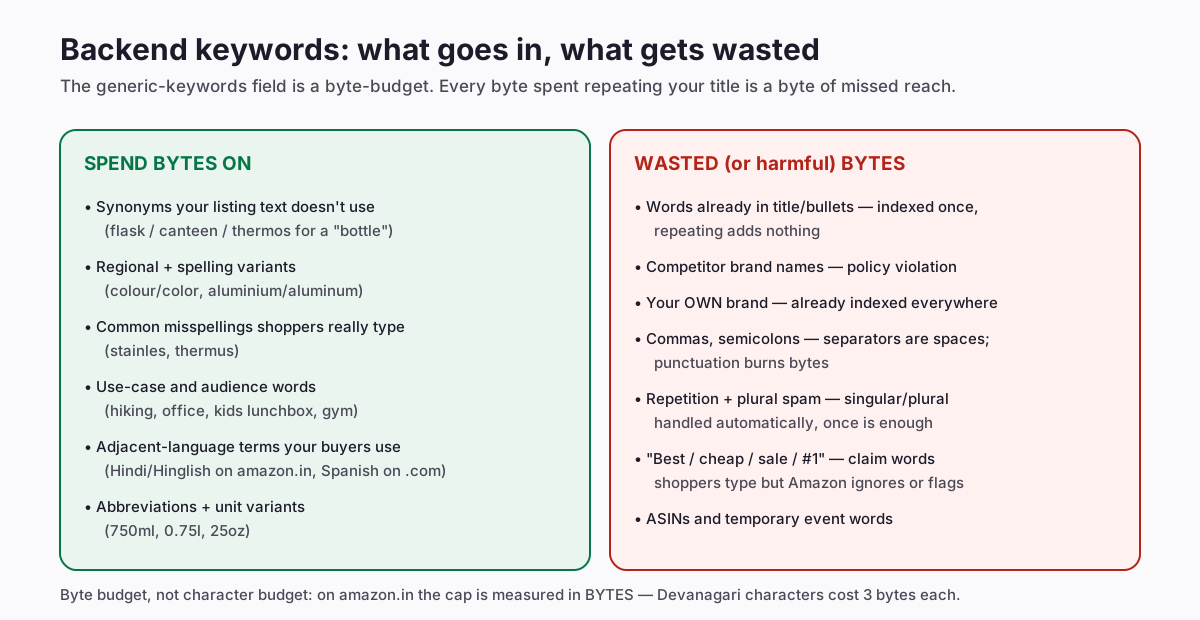
Three rows of the "spend" column deserve expansion:
Synonyms are the core job. Your title says "water bottle"; shoppers also search flask, canteen, thermos, sipper. Visible copy can't chase every synonym without reading like spam — the backend can, invisibly. The same logic covers your product's category dialects: what one buyer calls a "yoga mat" another calls an "exercise mat".
Adjacent languages matter more than most guides admit. On amazon.in, meaningful search volume arrives in Hindi and Hinglish; on amazon.com, in Spanish. A backend carrying "botella de agua" or a Devanagari term captures searches your English copy never will — with the byte caveat below.
Use-case words widen the funnel honestly. "Hiking", "office", "gym", "kids lunchbox" — the contexts your product serves — connect you to how shoppers actually phrase needs ("bottle for gym"). This is also exactly the vocabulary your search term report will confirm or deny later.
On the waste side, one entry is more than waste: competitor brand names in backend fields violate Amazon policy and can trigger listing suppression — conquest belongs in product targeting, never in indexing fields.
The byte-cap trap: bytes, not characters, per marketplace
Here's the technical detail that silently breaks international listings: the field's limit is measured in bytes, and it differs by marketplace. Most marketplaces enforce a small cap (on the order of a couple hundred bytes) — and in UTF-8, a byte is only a character if the character is basic Latin. A Devanagari character costs three bytes; an accented European character costs two. A field that "fits" at 180 characters of Hindi is actually ~540 bytes — far over cap — and over-cap fields can be rejected or silently truncated, killing the indexing you thought you had.
Practical rules that follow:
- Count bytes, not characters, before saving — especially with any non-Latin content. (Most spreadsheet tools have a byte-length function; naive character counts are the trap itself.)
- Front-load by value: put the highest-value unique words first, so if anything ever truncates, the tail dies rather than the head.
- Spaces as the only separator. Commas and semicolons are pure byte waste — Amazon treats spaces as delimiters.
- Non-Latin terms earn their triple price only if searched: a three-byte-per-character Hindi term must carry real search volume to beat three one-byte-per-character English synonyms it displaces. Choose deliberately.
(This nuance is one we handle programmatically — AIAdKing's listing engine validates byte budgets per marketplace before publishing, because we learned the truncation failure the empirical way.)
Building the field: a worked example
A steel water bottle, listed on amazon.com, title already containing "stainless steel water bottle insulated 750ml leak proof". Building the backend:
- Synonym layer:
flask thermos canteen sipper tumbler— five words the visible copy doesn't use. - Variant layer:
aluminium colour litre 25oz— regional spellings and unit variants (750ml is already in the title; 25oz isn't). - Misspelling layer:
stainles thermus— only misspellings with plausible volume; resist the urge to enumerate every typo. - Use-case layer:
hiking camping gym office school cycling— the contexts the bullets didn't cover. - Adjacent-language layer:
botella agua termo— Spanish basics for the US marketplace.
Total: ~20 unique words, spaces only, well under cap, highest-value first. Notice what's absent: no "water", no "bottle", no "steel" (title already indexes them), no "best", no brand names, no repetition. Every byte either adds a search the listing couldn't serve before or it goes.
The quarterly refresh workflow
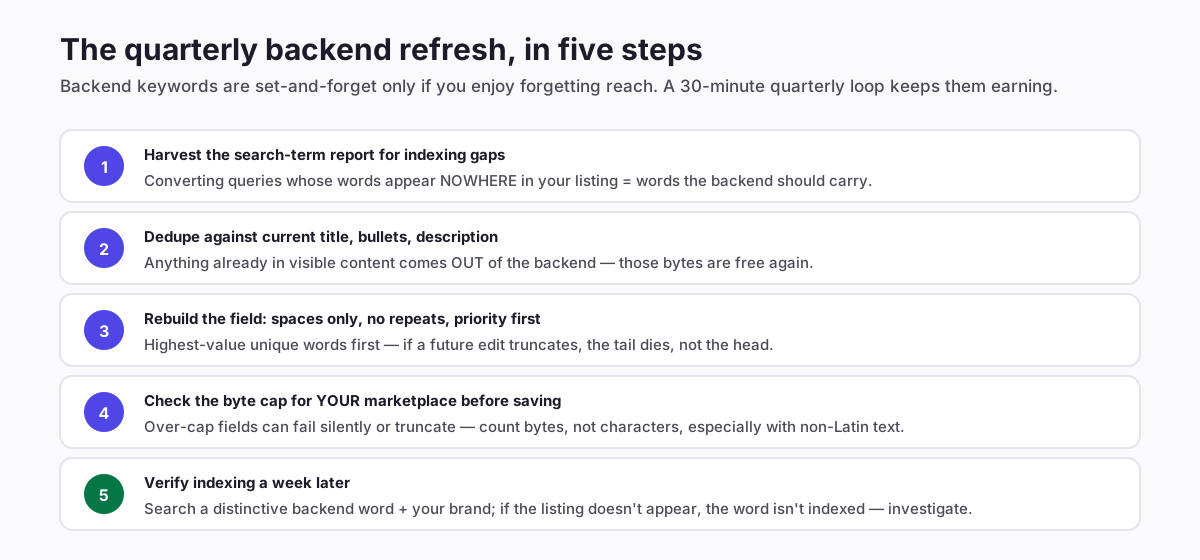
Step 1 is where the compounding lives, and it inverts the usual direction of this field: instead of guessing what shoppers might type, you read what they did type. The search term report regularly surfaces converting queries containing words that appear nowhere in your listing — each one is a proven-demand word your backend should carry (and often a title-edit candidate if it converts strongly enough). This loop is also why backend work belongs to the same weekly-to-quarterly rhythm as your ads: the two feed each other, ads discovering vocabulary and the backend indexing it.
Step 5 — verification — is the discipline nobody does: a week after saving, search a distinctive backend word plus your brand. Listed? Indexed. Absent? Something failed — over-cap truncation, a policy filter, or a flat-file overwrite (bulk feeds and listing-health incidents both routinely clobber backend fields silently, which is half the reason the refresh is quarterly rather than "once").
Backend keywords and your ads: the two-way street
The backend field and your PPC account are usually managed by different routines and are actually one system:
- Backend → ads: auto campaigns target from your listing's indexed content, backend included. A richer, cleaner backend literally widens what your auto campaign can discover. Garbage in the field becomes garbage traffic you'll pay to negate.
- Ads → backend: converting search terms whose words your listing doesn't contain are indexing gaps found at your expense — paid discovery whose findings should be banked into free organic eligibility. Sellers who never close this loop keep paying auto-campaign CPCs for searches their backend could have served organically.
- The shared audit: if close-match auto traffic converts poorly across the board, Amazon's idea of your product is off — and the backend is one of the three levers (with title and bullets) that resets it.
Run the loop in both directions quarterly and the field stops being a set-and-forget chore — it becomes the cheapest acquisition channel you own, funded by data your ads were already buying.
Multilingual fields in practice: an amazon.in worked case
Because the byte trap bites hardest on non-Latin marketplaces, one concrete walkthrough. A seller lists the same steel bottle on amazon.in, where meaningful search arrives in three registers: English ("water bottle steel"), transliterated Hinglish ("pani ki botal"), and Devanagari ("पानी की बोतल").
The byte math decides the strategy. English words cost one byte per character; Hinglish, being Latin script, also costs one; Devanagari costs three. On a cap of a couple hundred bytes, a single short Devanagari phrase can consume a fifth of the entire field. So the practical priority order inverts what intuition suggests:
- Hinglish first. It captures the spoken-language searches at Latin-script prices — "pani ki botal", "garam thanda bottle" — the highest reach-per-byte in the field.
- English synonyms second, exactly as on any marketplace.
- Devanagari last and least — only the one or two terms whose search volume you'd genuinely bet on, because each costs triple.
Then the verification step becomes non-optional: mixed-script fields are precisely where silent truncation strikes, and a truncated field fails from the tail — which is why the priority ordering above doubles as damage control. (Sellers on amazon.in should also read the India-specific notes; the fee and language landscape shifts several defaults.) The general lesson for every marketplace pair: one listing, per-marketplace backend fields — a copy-pasted field is wrong in at least one place, and usually both.
Keeping it maintained without remembering to
Like everything else in this series, the backend workflow decays exactly as fast as human routines do — and its failure is uniquely silent: nothing alarms when a flat-file overwrites the field or a marketplace rejects an over-cap save. AIAdKing folds the loop into the product: listing rewrites that build byte-validated backend fields per marketplace, search-term harvests that flag indexing gaps automatically, and listing-health monitoring that notices when a field changes underneath you. All of it previewable before publishing, flat fee, official APIs only.