
What each match type actually matches
The mechanics first, because two of them are commonly misremembered:
- Broad matches your keyword's words in any order, plus close variants, plus — the part that surprises people — related terms and synonyms Amazon judges relevant. "Steel water bottle" on broad can serve "insulated metal flask". This reach is the point of broad, and also its bill.
- Phrase requires your phrase, in order, somewhere inside the query. "Steel water bottle" on phrase serves "large steel water bottle for gym" but not "water bottle steel large".
- Exact serves only the term itself and close variants (plurals, obvious misspellings). Full control, zero discovery.
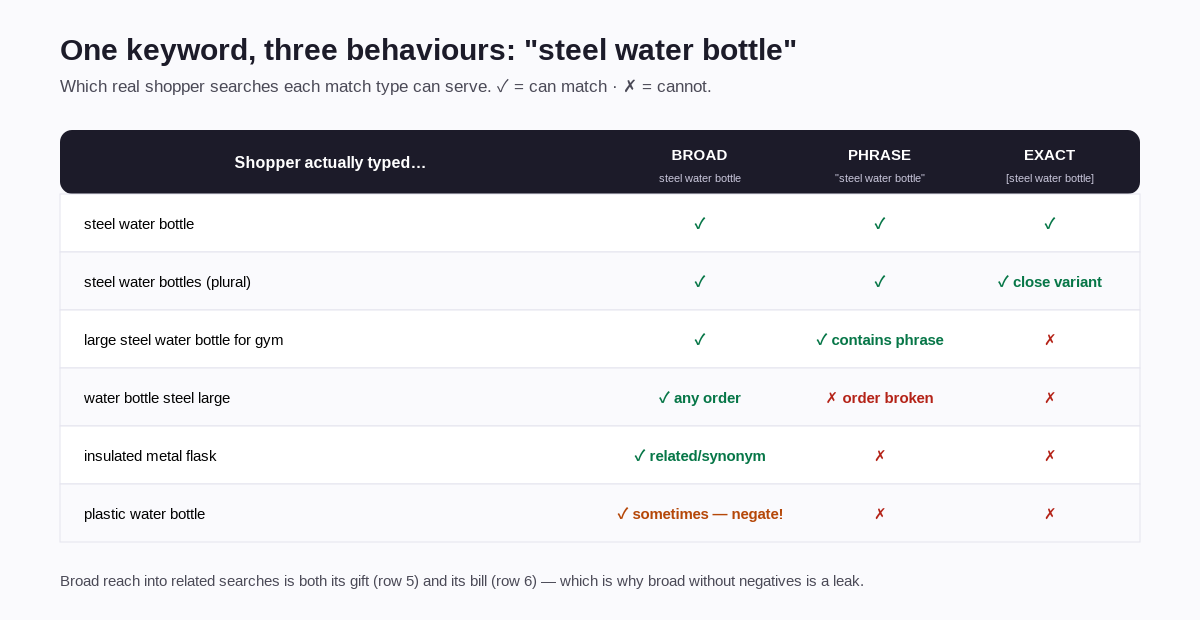
Note the last row: broad happily serving "plastic water bottle" against a steel product is not a malfunction — it's broad doing its job of exploring adjacent demand. Whether that exploration is investment or waste depends entirely on whether anyone is reading the results and negating. (Auto campaigns are effectively a fourth "match type" — Amazon choosing targets from your listing content — and everything below applies to them doubly.)
The funnel: discovery flows down, negatives seal upward
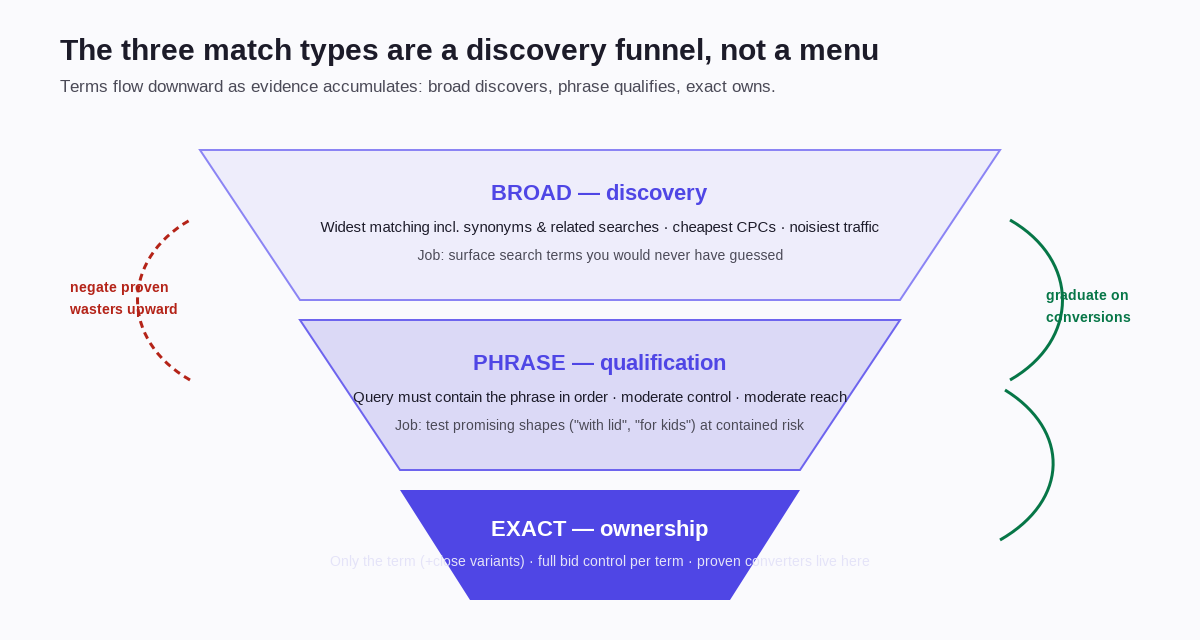
The system in one paragraph: broad (and auto) campaigns run at modest bids as scouts. Their search-term reports get reviewed weekly. A term that converts earns graduation — added as exact match with its own bid in a campaign whose budget is protected — and is simultaneously negated as exact in the scout campaign, so the scout stops competing with the owner. A term that proves it wastes (real clicks, zero orders) is negated where it spends. Everything without a verdict yet is left alone to accumulate evidence.
The two seals are what most setups miss:
- Graduation without negation upstream leaves the broad campaign serving the term at discovery bids — you now bid against yourself and pay more for traffic you already owned. This is mistake 5-and-6 territory and the single most common structural leak we see.
- Negation without the thin-data rule kills tomorrow's winners. Clearly irrelevant terms can be negated on sight; plausible ones need a real sample first — the negation guide carries the decision flow.
Bidding by level: the discount ladder
Because certainty rises as terms move down the funnel, bids should too. A workable ladder relative to what a term's evidence supports:
- Exact (owners): full evidence-supported bid — derived from the term's own conversion rate, your price and margin (the arithmetic). These are the only targets where a top-of-search modifier should even be considered, because only here do you know the term deserves the premium slot.
- Phrase (qualifiers): ~70-80% of the exact-equivalent bid. You're paying for a mixture of the proven shape and its unknown neighbours; the discount prices the uncertainty.
- Broad + auto (scouts): ~50-60%. Low enough that exploration stays cheap, high enough to actually win impressions. A scout that can't win any auctions discovers nothing — the fix for a silent broad campaign is usually a small bid raise, not abandonment.
The ladder also self-corrects a classic anxiety: "won't broad steal my exact traffic?" Not when exact outbids it by design — Amazon serves the higher-bid eligible target, and the negation seal makes it structural rather than probabilistic.
Structuring campaigns around the funnel
The funnel maps cleanly onto a campaign structure per product (or tight product family):
- One auto campaign — Amazon's own targeting as scout layer zero. Modest budget, never neglected: it's reading your listing, so it doubles as a listing-relevance signal.
- One broad/phrase discovery campaign — your guessed seed keywords at scout/qualifier bids.
- One exact campaign — the graduates, each with its own bid, carrying most of the budget. This is the campaign whose budget cap you never want hit at 2pm.
Three campaigns per product is more than some minimalist setups and far fewer than keyword-dump chaos. The structure's value is that location encodes evidence: where a term lives tells you what's known about it, and the weekly review becomes mechanical. (The full structural argument — including when to split further by margin tier or deal status — is its own post in the mistakes guide's keyword-dumping section.)
The weekly graduation review, step by step
Fifteen minutes, same order every week:
- Pull the search-term report for scouts and qualifiers, last 30-60 days, sorted by spend.
- Graduate: terms with conversions at viable ACoS → add exact (owner campaign) at evidence-supported bid → negate exact in every scout that matched them.
- Negate wasters: real clicks, zero orders, plausibly-relevant-but-proven-not → negative exact where they spent. Clearly irrelevant → negate on sight, sample size be damned.
- Promote shapes, not just terms: when multiple converting terms share a pattern ("… with lid", "… for kids"), add the pattern as phrase in the qualifier layer — you're now farming the shape deliberately instead of waiting for broad to stumble on each variant.
- Check the ladder: any scout consistently outspending the owner on a shared theme means bids or negatives have drifted — re-seal.
Skipped weeks are where the system decays: in our live benchmarks, about one ad dollar in nine sits on already-proven wasters — almost all of it broad and auto spend nobody reviewed.
Match types during events and launches
Two situations bend the standard system:
Launches invert the funnel budget. A new product has no proven terms, so scouts temporarily carry the spend — at higher-than-scout bids, because you're buying evidence on a deadline, not just exploring. The discipline is the end date: after the launch window, the surviving graduates take over and scout bids drop back to the ladder. Launch scouting without the end date is just an expensive habit.
Events compress the timeline. During deal weeks, broad discovers at five times the price — so the pre-event prep (graduate and seal beforehand) matters more than any in-event cleverness, and the post-event harvest runs in two passes because attribution lags. Event weeks are when exact campaigns earn their keep and scouts should be kept on a shorter leash.
Worked example: one term's journey through the funnel
Follow one real-shaped journey to make the system concrete. A seller of insulated bottles runs the blueprint. Week 1: the auto campaign surfaces the search term "water bottle that keeps ice 24 hours" — a phrasing nobody would have guessed — with two clicks. No action: no verdict yet.
Week 3: the term has 11 clicks, 2 orders, ACoS 24% against a 38% break-even. Graduation: it's added as exact match in the owner campaign at a bid derived from its own ~18% conversion rate, and negated exact in the auto and the broad discovery campaign the same evening. From this point the term's traffic arrives at the owner's controlled bid — not the auto's discovery bid.
Week 4: the seller notices the shape — "keeps ice N hours" — recurring across three more converting variants, and adds the phrase "keeps ice" to the qualifier layer at 75% bids. The funnel is now farming the pattern deliberately.
Week 9: the exact term has 60 clicks of history; its bid has taken two glide steps down as its position stabilised, and it sits at 21% ACoS as a permanent asset. Total human time across nine weeks: perhaps eight minutes. Multiply that journey by every term worth owning and you have the honest job description of Amazon PPC — which is why the funnel, not the individual match types, is the thing to master.
Running the funnel automatically
Everything above is a loop with thresholds — which is why it automates well and decays fast when manual. AIAdKing's nightly cycle runs the funnel continuously: converting terms graduate to exact with upstream negation applied in the same pass, proven wasters are negated on evidence thresholds, the bid ladder re-derives from current conversion rates, and every move is logged with its reason — previewable in shadow mode until you're ready to let it run. The weekly review becomes reading a change log instead of building one. Flat fee, no percentage of spend.