
The three phases inside one week
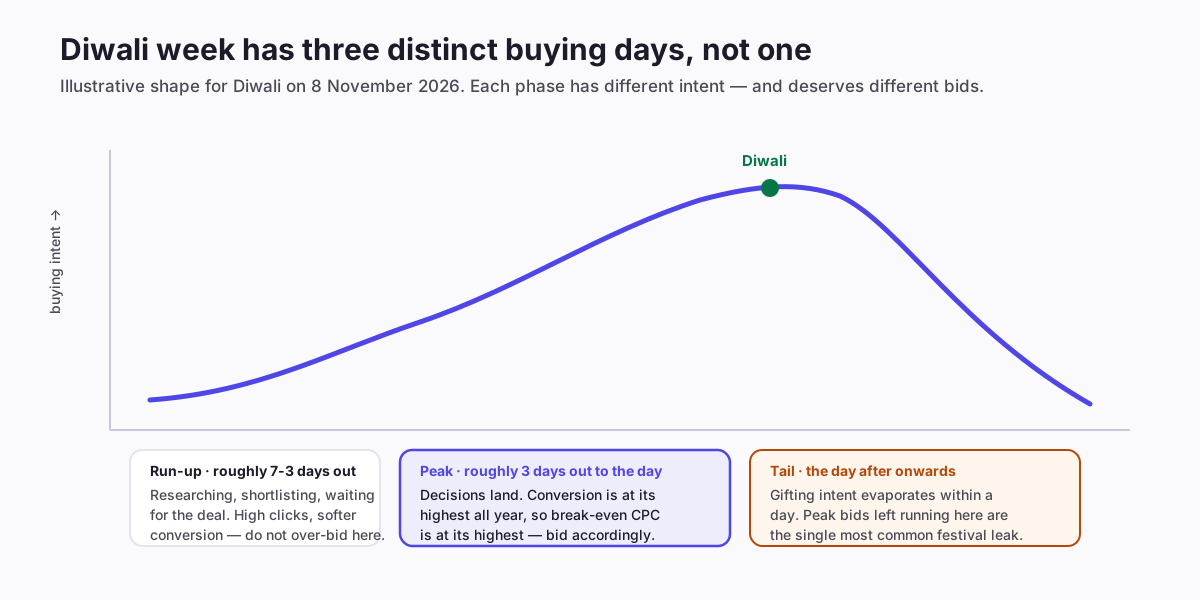
Treating the week as one event is the mistake that makes it expensive. Each phase has different economics:
- The run-up brings researchers — shortlisting, comparing, waiting for the deal to land. Clicks are plentiful and conversion is softer than the volume suggests, so this is the phase where over-bidding quietly burns the budget the peak needed.
- The peak is where decisions land, conversion reaches its annual high, and therefore — by the break-even arithmetic — the highest bid you can justify all year is briefly correct.
- The tail starts within a day. Gifting intent is deadline-bound; once the deadline passes it does not decay gracefully, it stops. Peak bids left running into the tail are the single most common festival leak, and they are invisible in a week whose top-line numbers still look good.
The practical implication: the week needs two scheduled decisions written down in advance — when bids step up, and when they step back down. Both dates, in the calendar, before the week starts.
Two buyers, one product, different bids
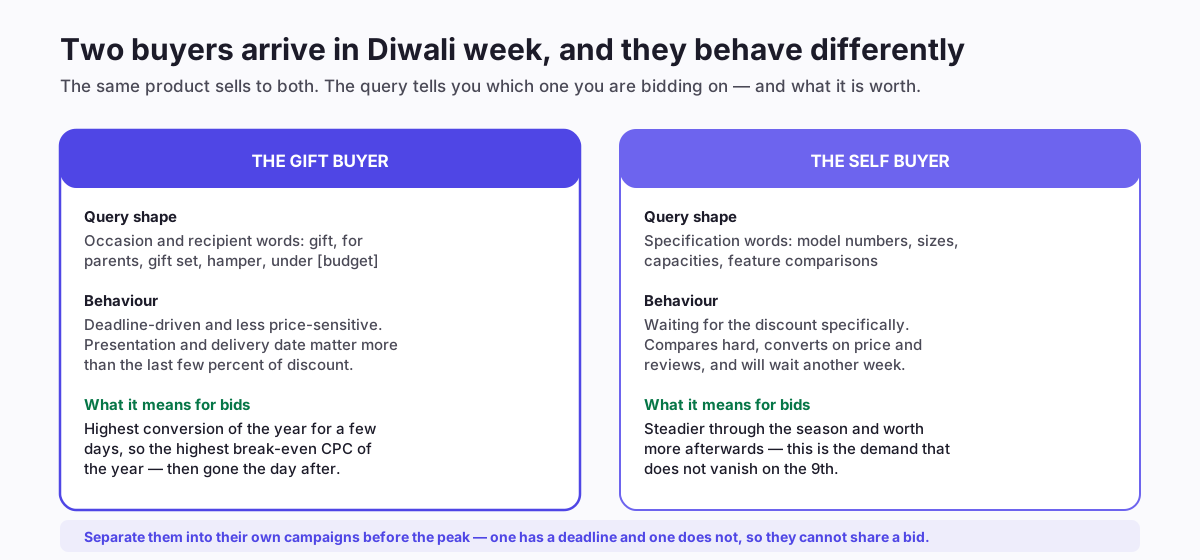
The separation matters because the two buyers have different deadlines, and a shared bid necessarily misprices one of them. Gift queries carry occasion and recipient language, convert hardest for a few days, and are worth an aggressive bid precisely because that window closes. Specification queries — model numbers, capacities, comparisons — belong to someone who wants the thing for themselves, will compare properly, and is still in the market next week.
So the structural move, made before the peak: put them in separate campaigns. That way the gifting side can be pushed hard and pulled back sharply on a date, while the specification side keeps running on ordinary efficiency targets without being dragged along by either move. Sellers who leave them blended end up choosing: either under-bid the gifting peak, or over-bid the self-buyer for a fortnight afterwards. Most choose the second without noticing.
What the maths actually permits at peak
The bid ceiling is not a feeling about how big Diwali is — it is margin times conversion rate, same as every other day. What changes at peak is the conversion rate, and the honest way to use that is to let the measured number move the bid rather than deciding in advance that the peak deserves more.
A worked example. Take a $34 gift-suitable product at 30% margin — about $10.20 to spend per order before it stops earning:
- Ordinary week, gift term converting at 8%: break-even CPC = $10.20 × 0.08 ≈ $0.82.
- Diwali peak, same term converting at 16% because the buyer arrived ready: break-even CPC = $10.20 × 0.16 ≈ $1.63. The permitted bid genuinely doubles — not because the event is exciting, but because twice as many clicks become orders.
- The day after, conversion back to 6%: break-even CPC ≈ $0.61. A bid still sitting at $1.63 is now paying nearly three times what the term can carry, on every click.
That last line is the whole risk of the week in one number. The peak bid is correct for about three days and badly wrong on the fourth, which is why the step-down cannot be left to whenever someone next opens the console.
Stock cover in the last week
By Diwali week, inventory is whatever survived the earlier waves of the festival season — there is no time left to fix it. What remains is triage, and three rules make it cleanly:
- Concentrate on what can actually ship. Budget on a product that runs dry mid-week buys a stockout at the worst possible moment: peak demand lost, and the organic position earned through the whole season unwound in days.
- Step bids down as cover thins rather than pausing outright. A gradual reduction sells the last units at improving margin and holds some position; a hard pause surrenders the placement to a competitor who then keeps it into December.
- Watch delivery promise, not just unit count. Gift buyers are buying an arrival date. A product that technically has stock but shows a delivery estimate past the occasion converts like it is out of stock, and paying peak prices for those clicks is pure loss.
If coverage is genuinely thin across the catalogue, the honest play is a narrower, better-funded campaign on the few products that can serve the week — not a thin spread that disappoints demand you paid a premium to attract.
The step-down, scheduled in advance
This is the section that pays for the article. The step-down fails for a predictable human reason: the peak worked, the dashboard looks excellent, and reducing bids on a machine that is visibly printing money feels wrong. Meanwhile the conversion rate that justified those bids has already gone.
What works is removing the judgement from the moment:
- Write the date before the week starts. "The day after Diwali, gifting bids return to their ordinary formula level." A date, not an intention.
- Step rather than cliff. Reduce over two or three days rather than in one move, watching settled conversion rather than same-day numbers — the attribution lag makes the immediate post-peak days read worse than they are, and a panicked over-correction costs the genuine residual demand.
- Leave the specification campaigns alone. They were never raised for the peak, so they need no reduction — which is exactly the benefit of having separated them.
- Log it. Next year's planning starts from this year's record; an unlogged festival season is one you have to learn again from scratch.
Listing details that decide the week
Peak traffic multiplies whatever the page already does, so the last sensible pre-peak hours go into conversion, not bids:
- Make the delivery promise obvious and achievable. For gift buyers this is frequently the deciding factor, ahead of price.
- Check the main image against the results page you actually appear on. During a deal event every competitor is also trying harder; a tile that looked fine in September can disappear in November.
- Answer the gifting questions in the copy. Is it presentable as a gift, what is in the box, what size or capacity is this variant. Unanswered questions cost more conversions in a rush than at any other time.
- Keep the offer legible. A discount a shopper has to work out is a discount that does not convert. Clarity beats depth at peak.
None of this is Diwali-specific advice so much as ordinary conversion discipline applied at the moment it is worth the most — which is precisely the argument for having done it in the run-up rather than the week itself.
What not to do this week
The expensive mistakes, in rough order of how often they show up:
- Restructuring campaigns mid-week. New campaigns and new targets need a settling window before their numbers mean anything. Changing structure during the peak throws away the one thing you have — measured history — at the moment you most need it.
- Judging by yesterday. Fresh festival data always reads worse than reality because orders attribute over following days. Panic edits on a Monday against Sunday numbers are how good weeks get sabotaged.
- Uncapping budgets "because it is Diwali". The permitted bid rose because conversion rose; the permitted waste did not. A cap is what stops a bad term spending peak money at peak speed.
- Negating aggressively during the peak. Click volumes are abnormal and a term can look convicted on three bad hours. Convictions belong on settled evidence — and the post-festival weeks are the cheapest, richest negation window of the year.
- Forgetting the step-down. Every item above costs a slice of the week. This one costs the following fortnight.
A three-day operating plan
What the week looks like when it is run rather than reacted to, using Diwali on 8 November as the anchor:
- Four to three days out. Gifting campaigns step to peak bids on the measured conversion lift. Caps raised to the planned ceiling, not removed. Delivery promises verified on the hero products. Stock cover checked against the remaining days rather than the month.
- Two days out to the day itself. Hold. Resist the urge to tune — this is the phase where the plan earns out, and mid-peak edits mostly add noise. One check a day: is anything out of stock, is anything capped out by noon, is any delivery promise slipping.
- The day after, onwards. Begin the scheduled step-down on the gifting side. Leave specification campaigns running normally. Start the harvest: the week just generated the densest search-term evidence of the year, and it depreciates.
Then the part most sellers skip: the festival season has a hangover, and November's comparison against Diwali week will look alarming on purpose. Knowing that in advance is what stops a normal seasonal decline from triggering a fortnight of destructive edits.
Letting the boring half run itself
The decisions in this guide are genuinely yours: which products can serve the week, what the ceiling is, when the step-up and step-down happen. The execution is not — nightly bid maths against each term's own settled conversion rate, caps holding when a term misbehaves at peak speed, stock alarms firing before a delivery promise slips, and the step-down actually happening on the date you wrote rather than the day you remember.
That split is why the week rewards systems: AIAdKing runs the nightly cycle on evidence, logs every action with its reason, and keeps the coverage signals in front of you while the peak is happening — at a flat fee that does not scale with festival spend, and with a preview mode if you want to approve each move first. Diwali week is short, the arithmetic is unforgiving, and the difference between a great week and an expensive one is mostly whether the step-down happened on time.