
The five phases at a glance
BFCM failure is almost never a bad Black Friday decision — it's an October decision that never happened. The calendar below is the whole strategy in one picture; everything after it is the detail per phase.
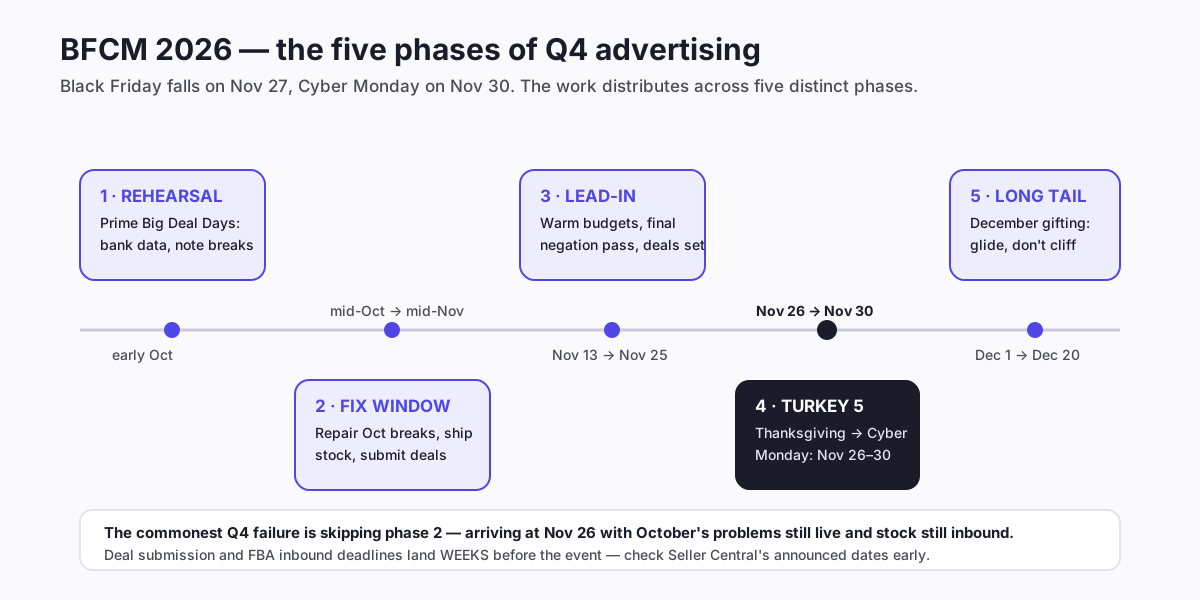
Two dates outrank every other deadline, and both land weeks before the event: Amazon's deal-submission cutoff for Black Friday week placements, and the FBA inbound deadline for stock to be checked in and sellable. Amazon announces both in Seller Central each autumn — typically putting the inbound cutoff in early-to-mid November. Put them in your calendar the day they're announced; every other item on this page can flex, those two cannot.
Phase 1 — treat October as your dress rehearsal
Prime Big Deal Days in early October generates, at smaller stakes, every failure mode BFCM will punish at full price: budget caps you didn't see coming, listings that suppressed under traffic, deals that under-delivered, search terms that burned money. Run it seriously — the full plan is in the Prime Big Deal Days playbook — and keep a written breakage list. That list is your Phase 2.
October's other gift is data: event-condition search terms and conversion rates. Terms that converted under deal traffic are your BFCM exact-match shortlist; terms that burned under surge conditions go straight to negatives before November repeats them at five times the cost. Do the harvest in two passes (T+2 and T+10) so late attribution doesn't mislabel your winners.
Phase 2 — the fix window (mid-October to mid-November)
Roughly four weeks to turn October's lessons into November's readiness:
- Repair every item on the breakage list. Budget caps that killed winning campaigns, listing issues that took days to fix, repricer floors that cost you the Buy Box mid-surge — each one costs multiples more if it recurs on Nov 27.
- Submit deals and coupons early. Approval queues lengthen as the deadline approaches, and a deal that misses Black Friday week placement doesn't get a second chance until next year.
- Ship inventory against the announced FBA cutoff — and then assume receiving runs slow anyway, because every seller ships at once in early November. Stock that is "inbound" on Nov 26 might as well not exist; your restock forecast should be measured against checked-in units only.
- Run the full campaign clean-up from the 12-mistakes checklist: negate proven wasters, graduate auto-campaign winners to exact match, set every product's break-even ACoS at its deal price. November CPCs are the most expensive tuition of the year — pay down the syllabus in October.
Phase 3 — the lead-in (Nov 13 to Nov 25)
The last two weeks are calibration, not construction:
- Warm budgets ~25-50% on proven campaigns from around Nov 13, so pacing is learned at pre-event CPCs — the same ramp logic as October, at bigger scale.
- Freeze structural changes by Nov 20. New campaigns, big bid experiments and ad-group surgery need learning time you no longer have; changes made days before the event enter the surge unproven.
- Final negation pass on Nov 24-25 using fresh mid-November data.
- Verify the boring things twice: deals showing as scheduled in Seller Central, repricer floors set consciously for deal week, budget caps lifted on the campaigns you expect to win, and payment method valid — an expired card silently pausing campaigns during Black Friday is a real and recurring seller story.
Phase 4 — the Turkey 5 (Nov 26-30): five different days
Treating Thanksgiving-through-Cyber-Monday as one uniform "event" wastes money, because the five days behave differently:
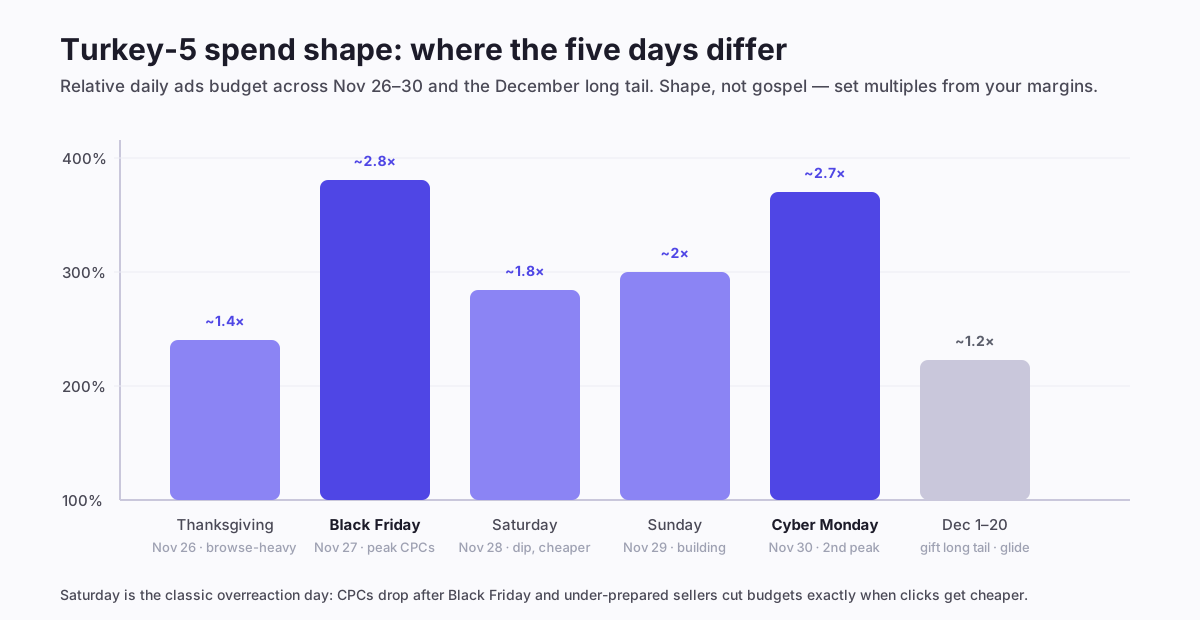
- Thanksgiving (Nov 26) is browse-heavy: shoppers build carts and compare. Moderate budget lift, and expect softer conversion — the clicks you buy today convert through the weekend.
- Black Friday (Nov 27) is peak CPC and peak volume. Give proven campaigns real headroom, check pacing morning and evening, and resist mid-day bid chasing — the discipline is identical to October's event-day rules, at higher stakes.
- Saturday (Nov 28) is the classic overreaction day: volume dips, CPCs fall, and under-prepared sellers slash budgets exactly when clicks get cheaper. If your ACoS held on Friday, Saturday is often the best-value day of the five.
- Sunday (Nov 29) builds toward the second peak — keep budgets up as Cyber Monday research begins.
- Cyber Monday (Nov 30) rivals Black Friday, with a category tilt toward electronics, software and gadgets. If that's your category, treat it as your true peak.
Across all five: watch budget-cap darkness twice daily, and let dayparting handle the hour-level shifts no human tracks across five consecutive days.
Deal math before deal week: a worked example
The most common BFCM profitability surprise isn't CPC inflation — it's forgetting that the deal price rewrites your break-even. Walk one concrete example, with round numbers for clarity:
A product lists at $40 with $10 product cost and roughly $14 in Amazon fees, leaving $16 margin — a 40% break-even ACoS. Run a 25% Black Friday deal and the price drops to $30 while costs stay put: fees fall a little with price, say to $12, so margin is now $8 — and break-even ACoS is $8 ÷ $30 ≈ 27%. The same campaign, the same keywords, the same bids that were comfortably profitable at 32% ACoS in October are now losing money on every deal-price order — during the highest-volume week of the year.
The correction is mechanical, not clever: recompute break-even at the deal price for every product running a deal (the calculator takes seconds per product), and size event bids against that number. Sometimes the honest conclusion is that a product's deal economics only work as a rank-building investment — which is a legitimate choice, as long as it's a choice you made in October and not a settlement-report surprise in December. The true-profit view is where that verdict eventually shows, several weeks after the applause.
Sponsored Brands, Sponsored Display and the badge effect
Three format-specific notes for the event window:
- Sponsored Brands: point headline ads at a Store page arranged around your deal items — event shoppers cross-buy, and a single-product landing wastes the basket-building moment. Refresh creative before the structural freeze (Nov 20), not during the event.
- Sponsored Display: fill views-remarketing audiences cheaply during the lead-in weeks, then let them convert at deal prices during the Turkey 5 — the browse-then-buy pattern of Thanksgiving week is exactly what retargeting audiences are built for.
- The badge effect: deal badges (Lightning Deal, Best Deal, coupon flags) lift click-through rate dramatically during event weeks — which means a competitor with a badge and a worse product can out-click you at the same placement. This is why the deal-approval check in Phase 2 sits above every bid decision: paying Black Friday CPCs for a badge-less listing in a badge-saturated results page is the quietest way to torch an event budget.
Whatever the formats report during the event, judge the week on the blended account view — event-week attribution flatters every format at once, and the settled TACoS a fortnight later is the number that was true.
Phase 5 — December is longer than the event
For many categories the Dec 1-20 gifting stretch out-earns the Turkey 5 — at lower CPCs. Three moves:
- Glide budgets down, don't cliff them. The post-event halo converts for days, and gift demand keeps search volume elevated for weeks. Step down as measured conversion normalises against your break-even, not on Dec 1 by reflex.
- Re-harvest immediately, in two passes (T+2 and T+10 again): the Turkey 5 produced a quarter's worth of search-term evidence in five days, and December's cheaper auction is the ideal place to deploy the new exact-match winners.
- Watch the shipping-cutoff cliff. When Amazon's last-arrival-before-Dec-25 dates pass, gift-intent conversion drops sharply — that, not the calendar month, is when December budgets should step down toward normal.
The one-page checklist
Print-friendly summary of everything above:
- Now: run October's event seriously; keep the breakage list; two-pass harvest.
- On announcement: calendar Amazon's deal-submission and FBA inbound deadlines; submit deals early.
- Mid-Oct → mid-Nov: fix the breakage list; ship stock; full negation + graduation pass; break-even at deal prices.
- Nov 13: begin the budget ramp on proven campaigns.
- Nov 20: structural freeze.
- Nov 24-25: final negation pass; verify deals, floors, caps, payment method.
- Nov 26-30: five different days — peak Friday and Monday, don't cut cheap Saturday; pacing checks twice daily.
- Dec 1-20: glide, re-harvest twice, step down at the shipping cutoff.
If reading that list feels like a second job on top of running deals, inventory and everything else Q4 demands — that's the honest case for running the ads side on automation: the nightly cycle does the harvesting, negation, bid-sizing and pacing continuously, shadow mode lets you approve changes during the high-stakes weeks, and the fee stays flat no matter what Q4 does to your ad spend — see pricing.