
First: is your ACoS actually high?
Two checks before any diagnosis, because both regularly produce false alarms:
The attribution check. Amazon attributes orders to clicks for days after the click happens. That means yesterday's ACoS is always overstated this morning, and a report pulled 24 hours after a change will "confirm" almost any fear you brought to it. Judge ACoS on a window that ends several days back — a 7-day-settled view is the honest minimum.
The benchmark check. "High" only means something against your break-even — the margin left after product cost and Amazon fees, as a percentage of price. A 45% ACoS is comfortably profitable on a 55%-margin product; a 25% ACoS quietly loses money at thin margins. Compute the real number on the break-even ACoS calculator before deciding you have a problem at all. For context on what real accounts run: in our live benchmarks the median 30-day settled ACoS across meaningful-spend accounts was 52.5% — far hotter than the "25-30% is good" folklore quoted around the web. Plenty of those accounts have a genuine problem; the point is that folklore isn't the reference, your margin is.
The two-parent rule: every cause is spend-side or sales-side
ACoS is a fraction: ad spend over ad sales. It rises when the numerator inflates, when the denominator sags, or both. That sounds trivial, but it's the whole diagnostic key — because the two sides have disjoint causes and disjoint fixes:
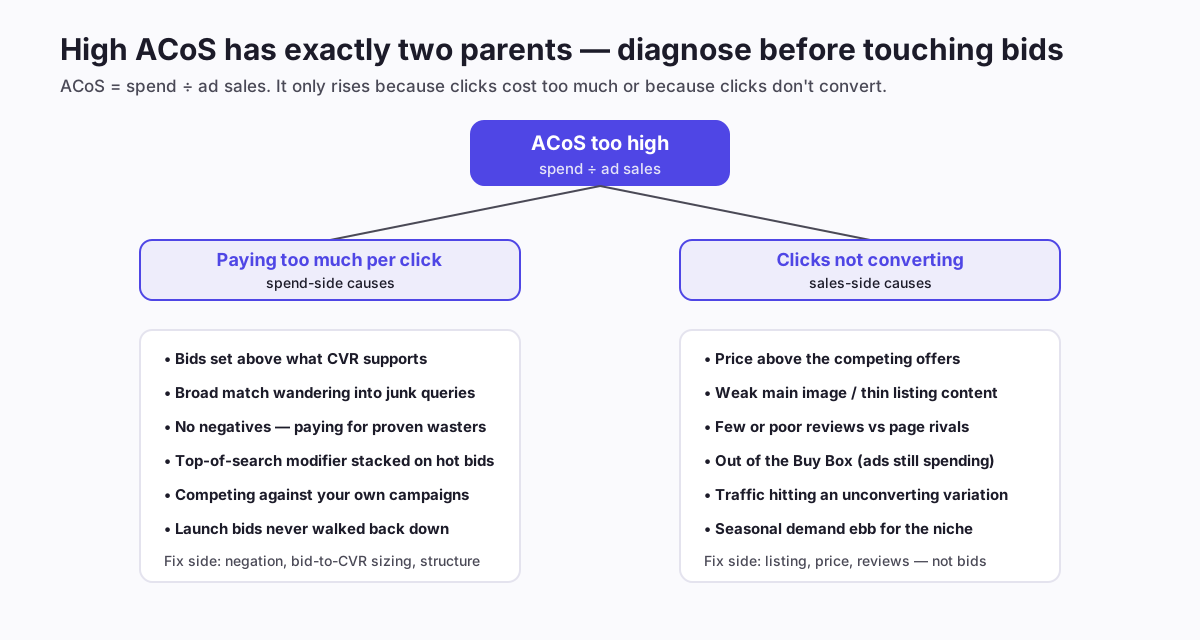
The classic misdiagnosis runs one way: a sales-side disease (listing can't convert the traffic) treated with spend-side medicine (cut every bid 30%). Spend falls, but sales fall further, rank decays, and three weeks later ACoS is worse on lower volume. If you remember one thing from this page: bid cuts cannot fix a conversion problem.
The 20-minute diagnosis, in order
Work the steps in sequence — each one either finds your cause or eliminates a whole family of causes:
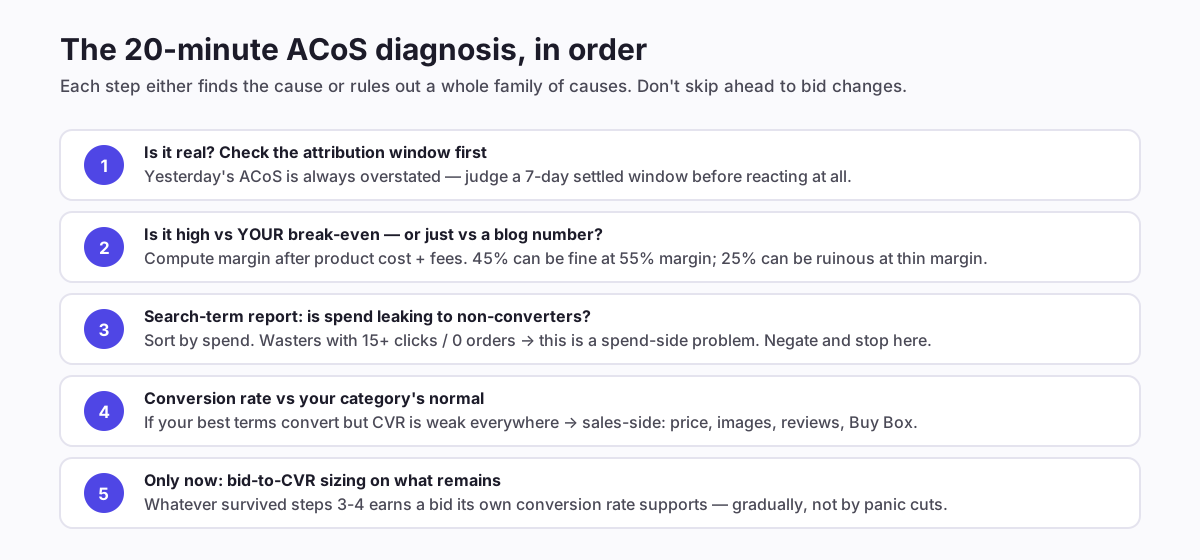
Steps 1 and 2 are the reality checks above. Step 3 is where most genuine problems surface, so it gets its own section next. Step 4 asks a simple question: on the search terms that should convert — relevant, decent volume — is your conversion rate meaningfully below what the page-one competition implies? If yes, the problem is your offer, not your auction. Step 5, bid sizing, comes deliberately last: it's the right move only after the leaks are plugged and the listing verdict is in.
Spend-side diagnosis: find the leaks
Open the Sponsored Products search-term report for the last 60 days and sort by spend. You're looking for three patterns:
- Proven wasters: terms with real click volume (rule of thumb 15+) and zero orders. Across live accounts we analyse, about one ad dollar in nine sits on terms that already met this bar. Each one is a negative-exact waiting to be added — the negative-keywords guide covers the full workflow, including the thin-data trap of negating terms that haven't had a fair sample yet.
- Broad-match wander: broad and phrase targets matching into queries only loosely related to the product. The tell is a long tail of one-and-two-click terms that collectively eat a surprising share of spend. Tighten match types on the offenders or fence them with negatives.
- Self-competition: the same search term served from multiple campaigns (typically an unharvested auto plus a manual). You're bidding against yourself and paying discovery prices for terms you already own — graduate the term to exact and negate it in the auto.
Also glance at placement data: a top-of-search modifier stacked onto already-hot bids can silently double your effective CPC in the most expensive slot. Placements deserve their own bids, set from their own conversion rates.
Sales-side diagnosis: why relevant clicks don't buy
If spend-side came back clean — negatives current, no wander, no self-competition — and ACoS is still high, the traffic is fine and the offer is losing. Check in this order:
- Buy Box first. Sponsored Products only serve while you hold the Buy Box, but a partial loss pattern — losing it during certain hours or on certain variations — shows up as conversion rot rather than an impressions cliff. Our Buy Box loss data shows how often live sellers are not holding the box across hourly checks; the loss-reasons triage covers causes and fixes.
- Price against the page. Search your own main keywords in an incognito session and look at the page as a shopper: if your offer is visibly beaten on price or reviews by the results around your ad, no bid can fix that arithmetic.
- Listing quality. Main image, title clarity, bullet substance, A+ content — a listing-health pass often explains a low CVR better than any ads metric. The listing-optimization guide is the fix-side companion.
- Seasonality honesty. Some niches simply ebb. If category demand is down, holding rank cheaply matters more than forcing last quarter's sales at any ACoS.
The fix, matched to the diagnosis
With a verdict in hand, the treatment writes itself:
- Spend-side verdict: negate the proven wasters, fence the wander, resolve self-competition, then re-size the surviving bids to each term's real conversion rate — gradually. Cutting a bid 40% overnight surrenders auction position you paid to learn; stepping down while watching a settled window keeps the sales you want. The lower-ACoS guide covers the glide-path approach in detail.
- Sales-side verdict: fix the offer — price positioning, images, bullets, reviews velocity, Buy Box stability — and hold bids during the repair rather than cutting them. The traffic you're buying is the audience for the fix you're shipping; go dark and you pay to re-earn the position later.
- Both (common on neglected accounts): spend-side first — it's faster and funds the patience the listing work needs.
And if the ACoS spike coincided with an event week — a Prime event, BFCM — re-read it against event dynamics before treating it as a trend: event CPCs inflate everyone's ACoS temporarily, and the event playbook covers what normal looks like there.
Three diagnostic patterns from real accounts
Composites of the cases we see most, to make the method concrete:
Pattern 1 — "the auto that never graduated." ACoS creeping from 28% to 44% over two quarters. Step 3 finds it immediately: one auto campaign carries 60% of spend, its top four converting terms never moved to exact match, and the long tail beneath them is packed with one-click wander. The fix took an evening — graduate the four winners, negate them in the auto, fence the wander — and the account's ACoS problem turned out to be a structure problem wearing an ACoS costume.
Pattern 2 — "the invisible price war." Spend-side checks come back clean, but step 4 shows conversion on the hero product halved in six weeks. An incognito search explains it in one screen: two new competitors at 15% lower price with deal badges. No bid change can win that page. The seller's real choices: match price and recompute break-even, or reposition the listing (bundle, quantity, differentiation) — a product decision that ads data surfaced but ads changes can't solve.
Pattern 3 — "the phantom spike." ACoS "exploded" on Tuesday's report after Monday's bid experiments. Step 1 ends the investigation: the window included two unsettled days. By Friday the same experiment read as a mild improvement. Nothing was wrong except the report timing — the most common high-ACoS emergency is an attribution artifact plus panic.
The pattern behind the patterns: each diagnosis pointed to a different lever, and two of the three would have been made worse by the instinctive across-the-board bid cut.
Keeping it low without weekly surgery
Every check above is repeatable — which means every check above decays without repetition. New search terms leak in weekly; conversion rates drift with price wars and seasons; a bid sized correctly in September is wrong by November. That maintenance loop — harvest, negate, re-size, verify on settled windows — is precisely what AIAdKing's nightly cycle automates: every bid re-derived from current conversion evidence, every proven waster negated on threshold, every change logged with its reason and previewable in shadow mode before it goes live. The result is an ACoS that's continuously diagnosed rather than annually rescued — for a flat fee, not a percentage of the spend it manages (pricing).