
Three slots, three economies
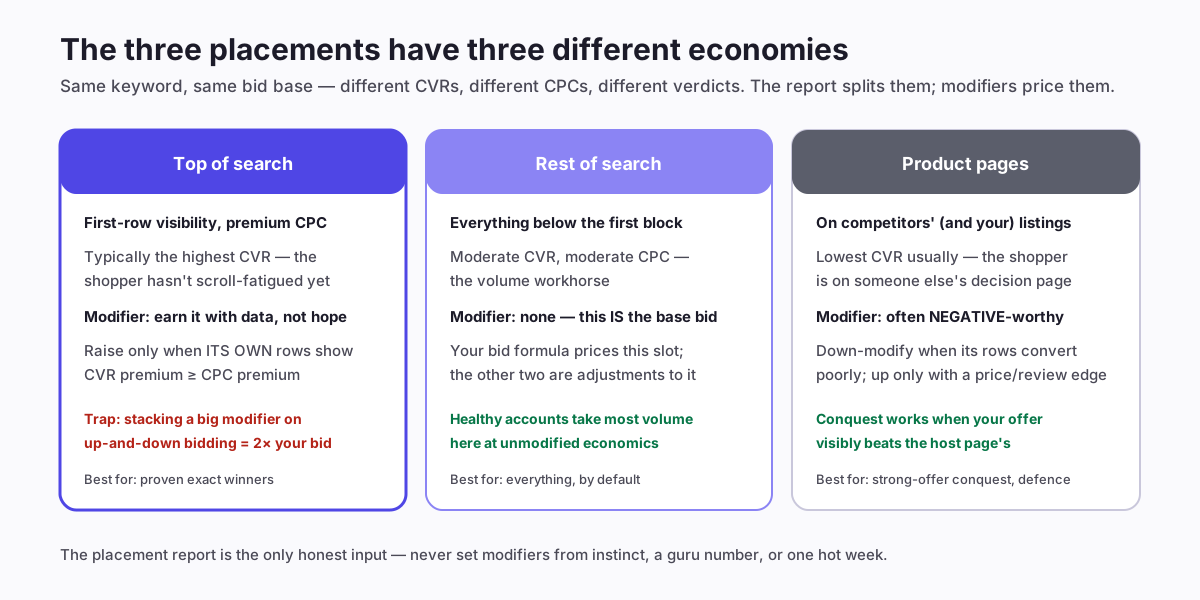
The structural insight most sellers miss: your base bid prices rest-of-search, and the other two placements are adjustments around it. Top-of-search costs more (Amazon effectively auctions the premium separately, and your modifier is your premium offer); product pages usually cost less but convert least, because the shopper standing on a competitor's listing is deepest into someone else's funnel. A single bid treating all three as one market is averaging across markets that can differ by 2-3× in conversion — the same category of error as one bid across an ad group, one level up.
The placement report: your only honest input
Everything in this guide runs off one report — Campaigns → the campaign → Placements (or the downloadable version in the reports suite), which splits each campaign's impressions, clicks, spend, orders and thus CVR/CPC/ACoS by the three slots.
Reading rules that keep it honest:
- Long windows only. Placement slices divide already-modest campaign data three ways; 60-90 days settled is the workable minimum, and low-volume campaigns may never support placement conclusions at all.
- Per campaign, not per account. Placement economics differ wildly between a brand-defence campaign (top-of-search on your own name: cheap, lethal) and a generic category campaign (top-of-search: a knife fight). Account-level placement averages are mush.
- Settled, as always: the newest days under-credit conversions everywhere, and placement rows inherit the same attribution lag as everything else.
- CVR premium vs CPC premium is the comparison that matters — absolute ACoS per slot is the output, but the premium ratio is what modifiers actually price. The worked math is next.
The modifier math, worked
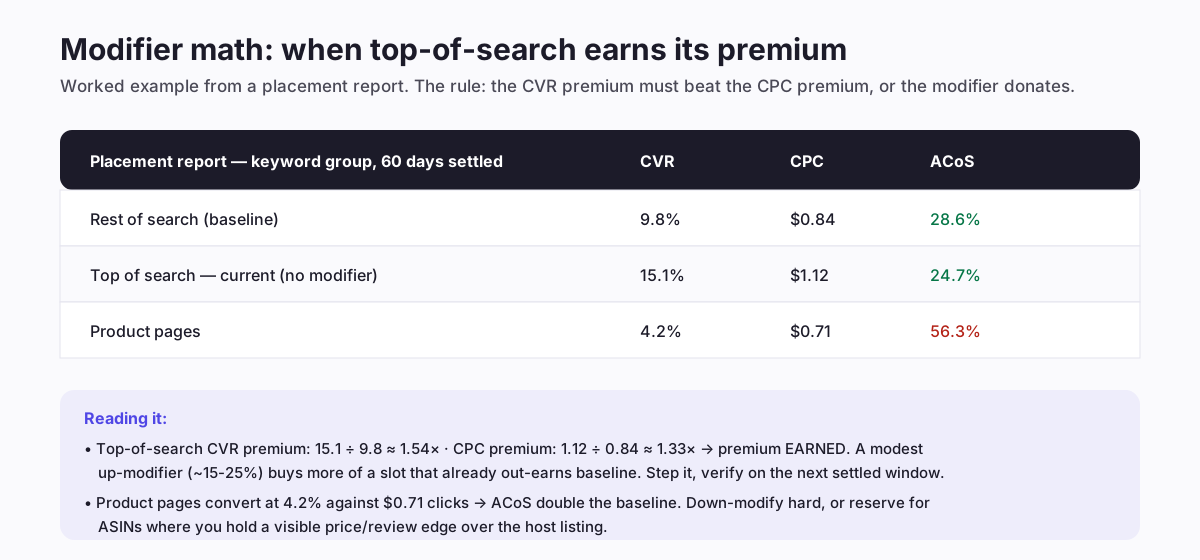
The rule in one line: a placement premium is earned when its CVR premium meets or beats its CPC premium. In the example, top-of-search converts 1.54× the baseline while costing 1.33× — the slot out-earns its price, so a modest up-modifier (15-25%, stepped like any bid change) buys more of a good thing. Had the ratios been reversed — common in fiercely-bid categories — the correct modifier is zero, and the correct response to "we need more top-of-search visibility" is improving CVR (listing, price, reviews) until the slot's math works.
Product pages in the example run double the baseline ACoS — the typical shape — which argues for down-modification or for restricting product-page presence to conquest situations where your offer visibly beats the host listing: cheaper, better-reviewed, or meaningfully differentiated. Conquest without an edge is a donation to the shopper's comparison process.
The stacking trap: modifiers multiply everything
The most expensive placement mistake isn't a wrong modifier — it's a forgotten one, multiplying quietly under other changes. The chain: your base bid × dynamic bidding's adjustment × the placement modifier = the effective bid, and each layer compounds the others:
- A $1.00 bid with a +40% top-of-search modifier bids $1.40 there.
- Switch that campaign to up-and-down dynamic bidding and Amazon may raise substantially further at top-of-search — the two premiums stack, and your $1.00 keyword can genuinely contest auctions at well over double its face value.
- Now run a glide-path step up of "just 5%" on the base bid: the effective top-of-search bid moves by 5% of the stacked total.
Hygiene rules that follow: audit effective CPCs (the placement report's CPC column tells the truth) rather than entered bids; change one layer at a time; and when inheriting an account, list every campaign's modifiers on day one — legacy modifiers from old agencies are among the commonest fossils in the archaeology accounts we see.
Per-placement strategy: who earns what
Where each slot deserves deliberate strategy rather than defaults:
- Top-of-search for proven winners only. The premium slot rewards certainty: exact-match terms with deep conversion history — the same terms that justify SKC isolation, whose per-term placement data is exactly what an SKC unlocks. Discovery traffic (broad, auto) has no business paying premiums to explore.
- Rest-of-search as the default economy. No modifier, base-bid arithmetic, most of the volume. If rest-of-search economics don't work, the problem is the bid or the listing, not the placement mix.
- Product pages, split by intent: defence (your ads on your own listings, denying the slot to rivals — a margin tax worth paying on heavily-pirated pages) and conquest (your ad on their listing — edge required, as above). Down-modify the generic remainder.
- Brand-defence campaigns invert the norms: top-of-search on your own brand terms is cheap and near-unloseable — the one context where aggressive top-of-search modifiers are safe by construction.
Placements during events
Q4 stresses placement economics in predictable ways. Top-of-search premiums inflate hardest during the Turkey 5 — everyone's modifier meets everyone else's — while the badge effect (deal-carrying rivals out-clicking you) hits top-of-search visibility worst, since that's where comparisons happen fastest. The event rules that follow:
- Set event modifiers in the lead-in, from October's rehearsal data (Prime Big Deal Days is your placement dress rehearsal too), and freeze them through the event — mid-surge modifier tinkering is bid-chasing wearing a costume.
- Deal products can hold their premiums: the badge earns back the CTR that full-price listings lose at top-of-search. No-deal products should drop event modifiers — their premium math collapses against badge walls.
- Product-page conquest gets briefly interesting when rivals stock out mid-event: their page traffic with no buyable offer is the one moment conquest converts without an edge. Opportunistic, short-lived, and only worth it if you're watching stock signals anyway.
The quarterly placement audit
Placement settings decay like everything else — CVR premiums drift, modifiers fossilise, campaigns inherit settings from forgotten eras. The 15-minute quarterly pass:
- Export placement data per meaningful campaign (90 days, settled).
- Recompute the premium ratios — CVR premium vs CPC premium per slot — and compare against current modifiers. Flag every modifier the ratios no longer justify, in either direction.
- List the stacks: any campaign combining up-and-down bidding with modifiers over ~25% gets its effective CPCs eyeballed against break-even.
- Check the fossils: modifiers on paused-and-revived campaigns, event modifiers that outlived their event, and anything nobody can explain.
- Step, don't slam: corrections ride the same settled-window cadence as bids.
Fold it into the structure audit — the two decay on the same calendar and share a review.
Worked case: two campaigns, opposite placement verdicts
Why placement work must be per-campaign, in one contrast:
Campaign A — brand defence. The placement report shows top-of-search CVR at 22% versus 12% baseline (premium 1.83×) with CPC premium of just 1.15× — brand searchers convert wherever they land, and the auction for your own name is cheap. Verdict: aggressive top-of-search modifier (+50% and step upward), because the slot out-earns its price massively and the downside is bounded by low absolute CPCs. This is the one context where big modifiers are safe by construction.
Campaign B — generic category terms. Top-of-search CVR 11% versus 9.5% baseline (premium 1.16×) with CPC premium 1.62× — everyone's modifier is fighting everyone else's in the premium slot, and the shopper at the top of a generic search is comparison-shopping, not committing. Verdict: zero modifier; take volume at rest-of-search economics and let competitors donate to the top-slot bidding war. Additionally, its product-page rows show 3.9% CVR — a hard down-modifier, except against two specific rival ASINs where this product holds a visible price edge, which move to a dedicated product-targeting campaign at formula bids.
Same account, same week, same report format — opposite correct answers. Any placement "strategy" that prescribes one modifier philosophy account-wide is answering before reading.
Placement pricing, nightly
Placement optimisation is the purest form of the pattern this whole series describes: per-slot evidence, ratio thresholds, small steps, constant decay — ideal automation territory and miserable manual territory, because the data is thin, the multiplication is error-prone, and the quarterly audit is the first ritual dropped in a busy season. AIAdKing's nightly cycle derives placement adjustments from each campaign's own settled slot data, audits effective (stacked) bids against break-even continuously, suspends normal placement logic during recognised event windows, and logs every modifier move with the ratio that justified it — reviewable in shadow mode before anything applies. Flat fee, details here.