
Why monthly budgeting fails specifically in Q4
For eight months of the year, "same budget every month" is a reasonable simplification — demand is roughly level and a mis-paced week costs little. Q4 breaks the simplification twice over. First, demand concentrates violently: a handful of days around Black Friday (Nov 27) and Cyber Monday (Nov 30) carry an outsized share of the quarter's conversions. Second, the price of attention moves with it — CPCs inflate exactly when volume peaks, so a dollar deployed in the wrong week buys less than half the outcome of the same dollar held for the right one.
A monthly frame can't see any of that. November as a month looks merely "busy"; November as four distinct weeks contains your quietest reserve-building days and the most expensive auction of the year. Budgeting the quarter as one pool with explicit shares per regime is the smallest change that fixes the structural problem.
The quarterly split: a worked example
Here's the shape on a concrete number — a seller with a $3,000/month baseline, so ~$9,000 for the quarter. The dollars are illustrative; the shares are the point:
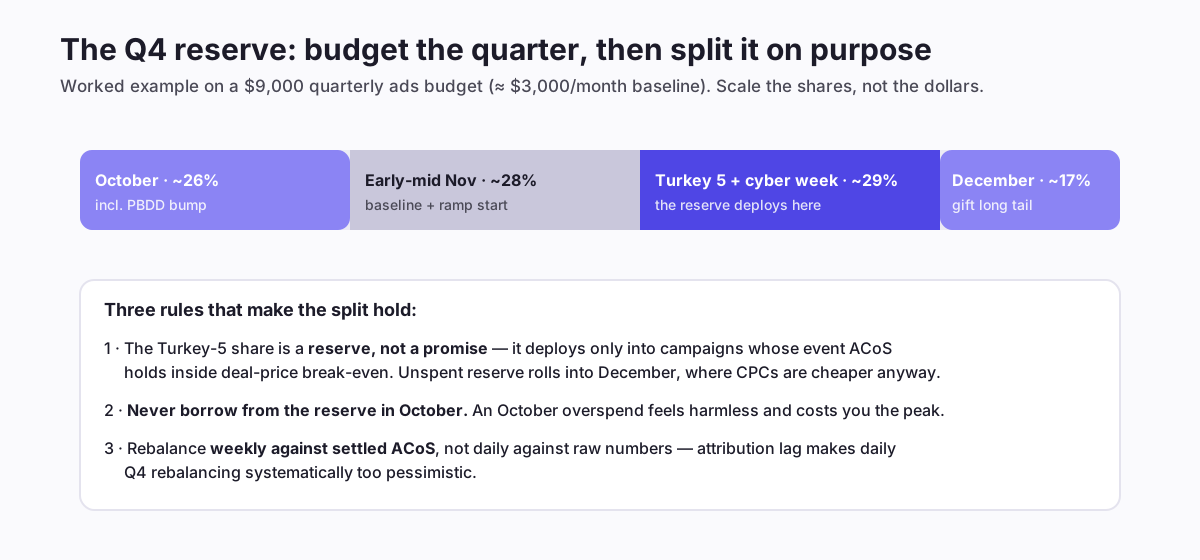
Notice what the split implies: the Turkey-5-plus-cyber-week share (~29% for roughly a tenth of the quarter's days) only exists because the mid-October-to-mid-November stretch runs at baseline. That flat stretch is the reserve being built. It will feel wrong in the moment — traffic is already rising, competitors look aggressive — and holding it anyway is the discipline that separates a planned Q4 from an improvised one.
The weekly pacing shape
Translated to a week-by-week line, the quarter looks like this:
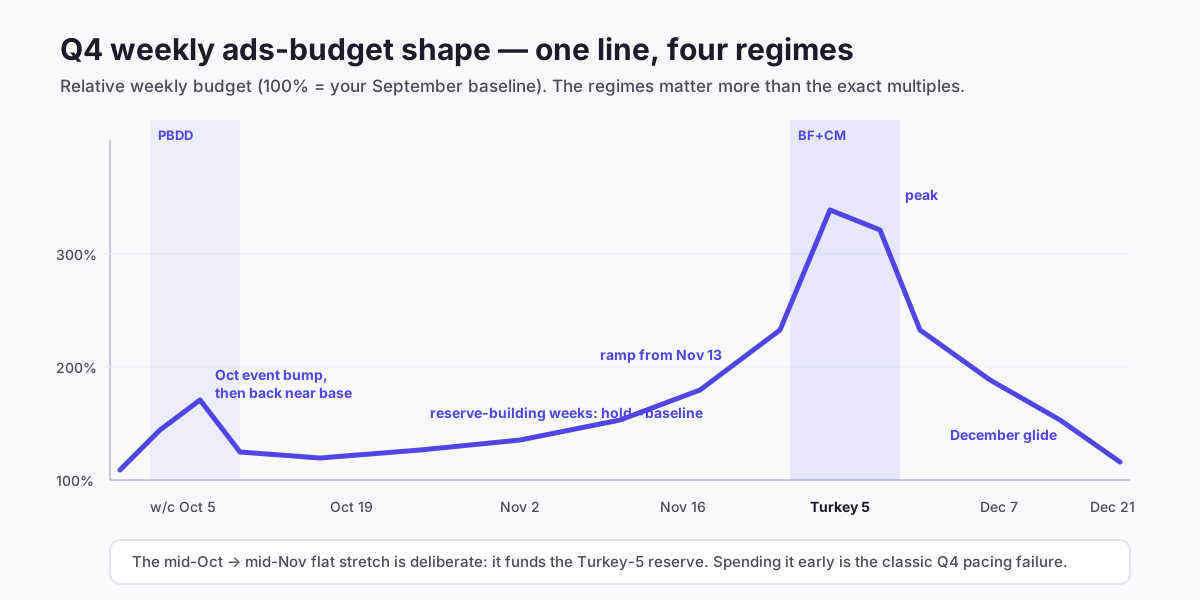
- Early October: a contained bump for Prime Big Deal Days — ramp the week before, headroom on event days, glide for a few days after. Then return to baseline; the halo doesn't justify event budgets for weeks.
- Mid-Oct → Nov 12: baseline. This is where the reserve is won or lost. Spend the attention (not money) on the campaign clean-up: negation, harvest, bid-to-conversion sizing — efficiency work that makes every later dollar go further.
- Nov 13 → 25: the ramp — lift proven campaigns ~25-50% so pacing is learned before the auction peaks, with a structural freeze from Nov 20.
- Nov 26 → 30: deploy the reserve as headroom on proven campaigns — 2.5-3× daily budgets they're allowed to use if delivery justifies it, checked twice daily.
- December: glide down 20-30% per step as conversion normalises, stepping decisively once the pre-Christmas shipping cutoffs pass.
The three rules that keep the plan honest
Rule 1 — the reserve deploys against evidence, not against the calendar. The Turkey-5 share isn't a spending target; it's permission. Each campaign earns its event headroom by holding an ACoS inside its deal-price break-even (recompute it — the calculator takes seconds, and the BFCM checklist shows why a 25% discount can nearly halve the number). A campaign that breaks the threshold loses its headroom mid-event; unspent reserve rolls forward into cheaper December clicks. Money you don't burn at peak CPCs is not a missed opportunity — it's December's budget.
Rule 2 — never borrow from the reserve early. Every October overspend is invisible in October and expensive in November. If an October campaign genuinely earns more budget on performance, fund it by trimming an October underperformer, not by raiding the Turkey-5 pool.
Rule 3 — rebalance weekly on settled ACoS. Attribution lag makes daily Q4 readings systematically pessimistic — event-window clicks convert for days afterward. A weekly rebalance against a 7-day-settled window reacts to truth; a daily rebalance reacts to noise, and in Q4 the noise always says "cut".
Per-campaign allocation inside the weekly envelope
The quarter-level split says how much the account spends each week; it doesn't say where. Three allocation habits matter most in Q4:
- Tier your campaigns before the ramp. Tier A: proven winners with deals and deep stock — they get ramp, reserve headroom and December glide. Tier B: profitable but unproven at scale — they get the ramp only, and earn event headroom by performing through mid-November. Tier C: experiments and strugglers — frozen at baseline (or paused) until January. Trying to lift everything equally is how the reserve evaporates without a decision ever being made.
- Protect winners from cap-outs. A Tier-A campaign that hits its daily cap by early afternoon at healthy ACoS is under-budgeted at the exact moment it's proving itself — that's where the next increment goes, before any new campaign gets a dollar of the pool.
- Mind stock as a budget input. Advertising a product whose forecast says it stocks out on Dec 8 is paying to accelerate your own stockout. Cap such campaigns deliberately and reroute their share to covered products.
What to track weekly (and what to ignore)
A Q4 budget review that works fits in fifteen minutes because it looks at few numbers on honest windows:
- Settled ACoS vs deal-price break-even, per tier — the deploy/hold/cut decision input. Ignore day-old ACoS entirely (attribution overstates it).
- Reserve remaining vs plan — one line: are we still on the split?
- Cap-out list — which campaigns went dark, at what ACoS, for how many hours.
- Stock cover per advertised product — weeks of checked-in inventory at current velocity.
- TACoS trend — the sanity check that ad spend is buying total growth, not cannibalising organic sales you'd have made anyway.
Everything else — impression counts, click-through rates, hourly wiggles — is diagnostic detail for when one of the five headline numbers moves. Tracking it daily in Q4 is how sellers talk themselves into breaking Rule 2.
Adapting the split to your situation
The shares above assume a mid-sized catalog with at least one deal running. Three common situations change the math:
Small budgets (under ~$1,000/month). At small scale, spreading a reserve across the whole Turkey 5 buys almost nothing on any given day. Concentrate instead: pick your single best day (usually Black Friday, or Cyber Monday for gadget-adjacent products) and your single best product, and deploy the reserve there at full depth. One properly funded day beats five starved ones — and December's cheaper clicks deserve a larger share of a small pool than the standard split gives them.
Single-hero catalogs. If one product is 70%+ of revenue, tiering is trivial but risk isn't: the whole quarter rides one listing's health. Shift budget attention to the non-ads guards — stock depth, Buy Box stability, listing readiness — because a mid-event suppression on the hero is your Q4. Keep a token budget on secondary products purely to keep their data warm for January.
No deals this year. Without badges, event days cost you relatively more per click (full-price CTR against badge walls). Flatten the curve: smaller Turkey-5 multiples (1.5-2× rather than 2.5-3×), a stronger December share where badge pressure fades, and lean into the no-deal playbook — normal-plus presence, strict list-price break-even, and patience while deal-chasers exhaust their budgets by mid-afternoon.
Pacing without the spreadsheet
Everything in this guide is arithmetic plus discipline — which is exactly why it tends to fail in practice: the arithmetic is easy, and the discipline competes with the busiest operational quarter of the year. AIAdKing's nightly cycle holds the discipline for you: budgets pace against settled evidence, winners get headroom before they cap out, bids stay sized to conversion rates as event dynamics shift hour to hour (dayparting included), and every change ships with a logged reason you can preview in shadow mode first. The fee stays flat regardless of what Q4 does to your spend — see pricing — so the budget math above never has to include the tool's cut of it.