
What isolation actually buys
Every control Amazon offers — daily budget, placement modifiers, bidding strategy, effectively even hour-of-day pacing — attaches at the campaign level. Inside a shared campaign, every term inherits compromise settings: the budget is communal (a hot term can drain it by 2pm and silence its siblings), the top-of-search modifier is an average of what different terms' placement economics deserve, and the campaign's reporting blends everything into totals that need un-blending before they inform anything.
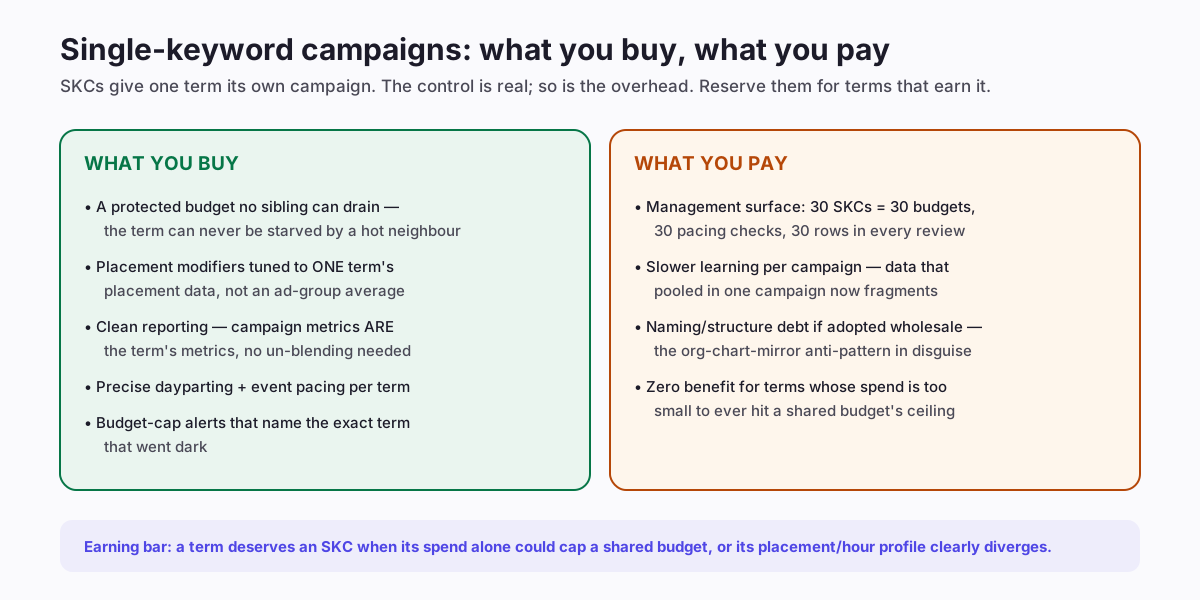
Isolation dissolves all of that for one term — which is precisely why it's valuable for the term that dominates a product's spend, and pure overhead for the forty terms that don't.
The wholesale version, and why it fails
The maximalist pitch — "every keyword deserves its own campaign" — sounds like rigour and works like entropy. Three failure modes arrive on schedule:
- Management surface explodes. Thirty SKCs are thirty budgets to pace, thirty rows in every weekly review, thirty places for drift. The attention that made your top terms excellent gets diluted across terms that never needed it.
- Learning fragments. Amazon's delivery optimisation, and your own judgment, both work better on pooled data. Twenty related long-tail terms sharing a campaign accumulate readable evidence together; scattered into twenty SKCs, each learns at a twentieth of the speed.
- Structure stops encoding evidence. In the blueprint, a term's location tells you what's known about it. When everything is an SKC, location says nothing — you've rebuilt the flat keyword dump, one campaign at a time.
The historical footnote: wholesale SKCs made more sense years ago, when placement controls were cruder and ad-group-level data was poorer. Amazon's tooling moved; the guru posts mostly didn't.
The three-gate promotion test
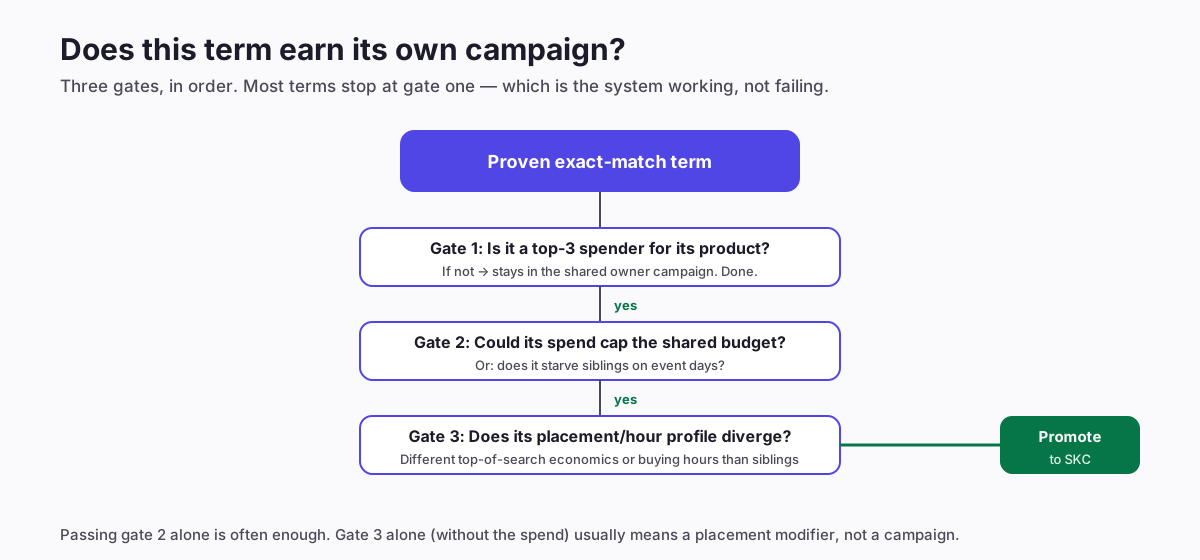
The gates in prose:
- Spend rank. Only a product's top few spending terms are even candidates. Below that, isolation solves problems the term doesn't have.
- Budget interference. The clearest earn: this term's appetite could cap the shared owner campaign (or measurably starves siblings on event days). Isolation here isn't preference — it's protecting both the term and its siblings from each other.
- Divergent profile. The term's top-of-search economics or buying hours differ meaningfully from its siblings' — so shared modifiers systematically misprice someone. Note the asymmetry: gate 3 without big spend usually calls for a modifier tweak, not a campaign.
Applied honestly, most products yield zero to two SKCs — typically the hero term that is the product's demand ("collagen powder" for a collagen brand) and occasionally a second term with weird hours or placement behaviour. That scarcity is the design working.
Setting one up properly
Promotion mechanics, in order:
- Create the SKC with the term in exact match only, bid carried over from its current evidence-derived level (glide-path state included — don't reset a bid that took eight weeks to calibrate).
- Seal everywhere: negative-exact the term in the shared owner campaign, the discovery campaigns and the auto — the same graduation seal, applied one level up. Skipping this puts the SKC in an auction against your own owner campaign.
- Set the budget from history: its recent daily spend plus real headroom (30-50%), because ending budget starvation was likely the point.
- Re-derive placement modifiers from the term's own data — the placement report rows for this term, not the old campaign's blended average. This is where the isolation dividend actually gets collected.
- Name it into your convention (
SKU · SKC · [term]) so reports sort and future-you knows the promotion was deliberate.
Then give it two settled weeks before judging: the move itself perturbs delivery, and week-one SKC readings mislead in both directions.
Running an SKC: what changes, what doesn't
What changes: pacing attention. An SKC's budget cap is now a single-term alarm — if it caps at healthy ACoS, that's the cleanest "raise budget" signal the account can produce, and during Q4 the term can be given event headroom without disturbing anything else. Placement modifiers become genuinely per-term levers. Dayparting, where used, tunes to this term's hours.
What doesn't change: the evidence rules. The bid still derives from conversion rate against break-even; steps still ride settled windows; the term can still decay (seasonality, competitor moves) and an SKC in decline gets stepped down like any target — isolation grants control, not immortality. And the term still belongs to the product's overall TACoS story: a hero-term SKC that grows while total sales stagnate is buying sales the product already had.
Demotion: the exit nobody plans
SKCs accumulate because promotion feels like achievement and demotion feels like admitting error. Neither is true — profiles change. Demote (merge back into the owner campaign, keeping the bid) when:
- Spend rank collapses: the term no longer threatens any shared budget — gate 2 un-passed. Seasonal hero terms do this every year.
- Its profile converged: placement and hour behaviour now match siblings, so shared settings no longer misprice it.
- The overhead outweighs the readings: honest test — did last month's reviews ever use this campaign's isolation for a decision? Three months of "no" is the answer.
Mechanics mirror promotion in reverse: add the term back to the owner at its current bid, remove the owner's negative for it, pause (don't delete) the SKC so its history stays queryable. The quarterly structure audit is the natural moment — stale SKCs are exactly the "archaeology stratum" it exists to catch.
Worked example: one product, one promotion, one pass
A yoga-mat seller's owner campaign holds nine exact terms. One — "yoga mat non slip" — runs 55% of the campaign's spend, caps the shared budget two days out of five (silencing eight siblings each time), and its placement report shows top-of-search converting half again better than the campaign average, which the shared 20% modifier underprices.
Gate 1: top spender, easily. Gate 2: actively capping — the promotion's real motive. Gate 3: divergent placement economics — bonus. Promoted: SKC at its current bid, budget set to recent spend +40%, top-of-search modifier raised to what its data supports, sealed everywhere. The owner campaign's remaining eight terms stop being silenced mid-afternoon — their orders rise without a single setting of theirs changing, which is the most commonly missed half of the SKC dividend.
Contrast the term that didn't earn it: "yoga mat with strap", 6% of spend, decent ACoS, ordinary profile. An SKC would add a budget to pace and a row to review, and change nothing about its delivery. It stays pooled — and that decision, repeated honestly, is what keeps the account legible.
SKC myths worth retiring
Because SKCs arrive wrapped in guru mythology, four claims worth explicitly unbelieving:
"SKCs get better CPCs." The auction doesn't know or care about your campaign structure — it sees a bid on a term from an eligible ad. Isolation changes your control over the bid, budget and modifiers; it changes nothing about the price of the auction itself. Sellers who saw CPCs improve after SKC migration usually also fixed self-competition in the same move, and the seal did the work.
"SKCs boost relevance/rank." Same reason: relevance attaches to the ad-listing-query relationship, not the container. An SKC neither impresses nor offends the algorithm.
"You need SKCs to control placements." Partially true at most — placement modifiers are campaign-level, so isolation does buy per-term modifiers. But if the term's placement profile matches its siblings', the shared modifier was already fine; gate 3 exists precisely because this benefit is real for a few terms and imaginary for the rest.
"SKCs are outdated / SKCs are mandatory." Both camps overclaim. They're a tool with a narrow, real use-case: dominant terms whose spend or profile earns isolation. The three-gate test replaces both slogans with a decision.
SKCs under automation
The three-gate test is threshold logic on spend shares, cap events and placement divergence — which means it can run nightly instead of quarterly. AIAdKing's cycle effectively administers it continuously: budget protection flows to terms before they starve siblings, placement bids derive from per-term data wherever the sample supports it, and structural promotions are proposed with their reasoning attached — previewable in shadow mode like every other change. The result is SKC-grade control where it's earned, without the campaign sprawl of the wholesale approach. Flat fee, details here.