
The comparison that matters
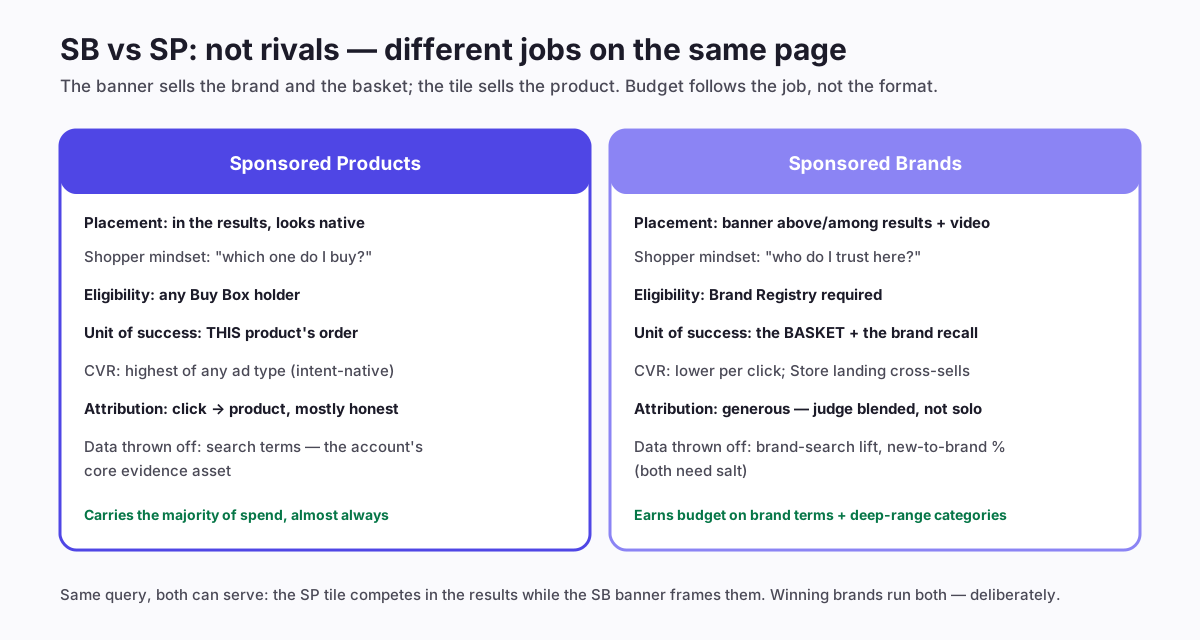
The single most decision-relevant row is unit of success. SP's unit is this product's order — clean, immediate, per-click. SB's unit is the basket and the brand impression: a banner click lands on a Store or product list, cross-sells across your range, and (unmeasured but real) plants a name shoppers re-search later. Comparing the two on per-click ACoS is measuring a fishing net by its performance as a fishing rod.
The second most important row is eligibility: SP is open to any Buy Box holder; SB needs Brand Registry. Unregistered sellers should stop reading here and go master SP — the ad-types guide covers why registration is a trademark project running in parallel, not a prerequisite for advertising well.
What SP does that SB can't
Three SP monopolies keep it the spend majority in virtually every account:
- Native intent capture. The SP tile sits inside the consideration set, at the exact moment of product choice — the highest-CVR real estate Amazon sells. Nothing in SB's formats touches that proximity.
- The search-term engine. SP (with its auto campaigns) generates the account's core evidence asset — the search-term report every other decision feeds on, SB's keyword choices included. An account's SB targeting is only as smart as the SP data behind it.
- Granular economics. Per-term bids sized to per-term conversion (the formula), placement modifiers, SKC isolation for heroes — SP's control surface is simply deeper, because its unit of success is measurable per click.
Practical consequence: SB budget is always carved out of provably-working SP budget, which sets its evidence bar. The four-question flow below is that bar.
What SB does that SP can't
The honest SB case, without the brochure gloss:
- Brand-term defence. On searches for your own name, SP tiles compete inside results a competitor's SB banner can still crown. Owning that banner is cheap (brand-term CPCs are low, CVR high) and its absence is expensive — a rival literally framing your own demand. If brand searches exist, this use-case alone justifies SB.
- The basket play. A banner click to a well-built Store enters a competitor-free space where the whole range sells. For genuinely deep ranges, per-visit economics can beat SP's per-click economics even at lower CVR — the cross-sell is the margin.
- Video in the results. SB video autoplays mid-results and pulls attention no static tile can. It has its own placement inventory, so it adds reach rather than cannibalising your tiles — and modest production (product doing its job, first two seconds) outperforms polished brand films.
- Category shelf presence. On category terms where your range is credible, the banner asserts "this is a brand, not a listing" — worth real money in categories where shoppers fear junk, worth little where they don't. Know your category's trust economics before paying for reassurance nobody needed.
The four-question budget flow
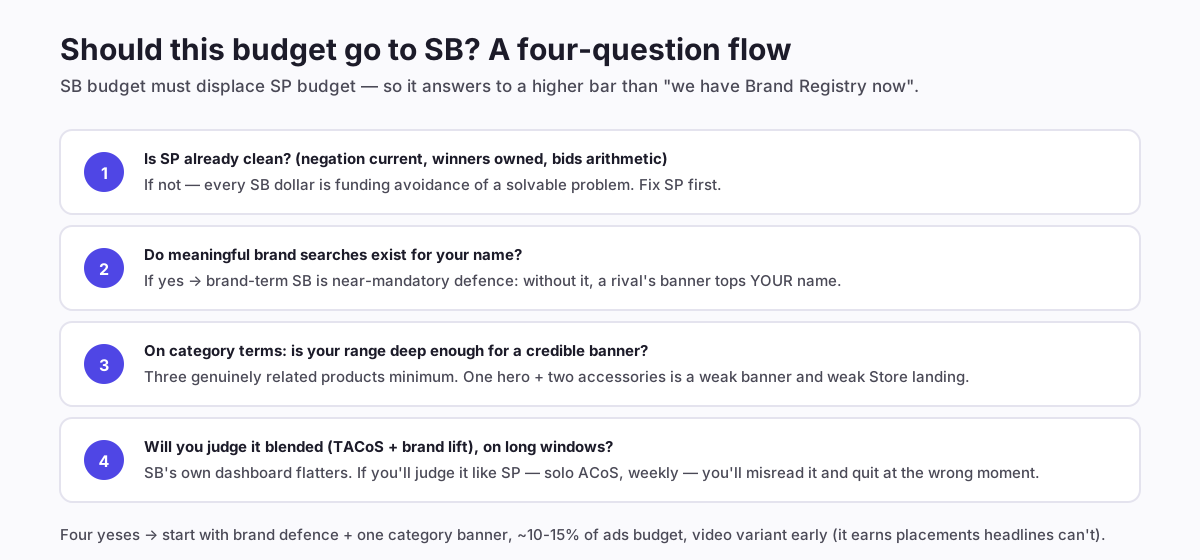
Question 1 is where most accounts should honestly stop for now: with a measured tenth of spend typically leaking through un-negated SP waste, "diversifying into SB" routinely functions as procrastination with a budget line. Clean SP first — the twelve-mistakes sweep — then carve.
Question 4 is the one sellers skip and regret: SB judged on solo weekly ACoS will look worse than SP almost every week, and the seller who set it up with SP expectations kills it at week six — usually right before its brand-search lift would have become visible. Decide the judgment framework before the first dollar: blended account TACoS, brand-search impressions trend, and Store-visit behaviour, on monthly windows.
Attribution: where the two dashboards diverge
Both formats' numbers need salt, but different salt:
- SP's distortion is temporal: orders land days after clicks (the settled-window rule), so recent ACoS overstates. Beyond that, click-to-this-product attribution is fairly honest.
- SB's distortion is structural: longer attribution paths, credit for basket items the click merely preceded, and "new-to-brand" percentages that count shoppers who'd have found you via the SP tile below the banner anyway. None of this makes SB worthless — it makes SB's own dashboard the wrong judge.
- The referee is displacement: the honest SB test is what happens to blended results when its budget moves. Pause a category banner for three settled weeks: if total brand sales hold, the banner was decorating; if they sag — particularly branded-search volume — it was working. Run the same test before scaling SB, in reverse.
(The ad-types guide's flattery-patterns section extends this to Sponsored Display, whose view-through attribution needs the most salt of all.)
Running both: the practical division of labour
For a registered brand with clean SP, the working setup:
- Brand-defence SB first: exact-match brand terms, headline + logo, Store landing. Small budget, near-permanent, judged loosely (its job is denial as much as conversion).
- One category banner where range is deepest: your best 3+ product family on its core category terms — the same terms your SP data already proved convert. SB keyword research is mostly reading your own SP search-term report.
- SB video as the third campaign, reusing the proven terms — its separate placement inventory makes it additive rather than cannibal.
- Budget shape: SB total around 10-15% of ads spend early, drifting toward 20% only as displacement tests justify it (the maturity curve).
- Negative coordination: keep SB off the ultra-long-tail — its banner wastes on hyper-specific queries where the shopper wants exactly one thing; leave those to SP tiles.
During Q4, the division sharpens: SB's browse-heavy value peaks in the lead-in weeks (brand-planting while shoppers research), while SP's peaks on the conversion days themselves — pace them on different curves.
Worked example: one brand's month, both formats
A kitchenware brand, five related products, clean SP, $3,000/month total. Split: $2,500 SP, $300 brand-defence SB, $200 category SB banner.
The monthly reading (settled): SP posts 26% ACoS against a 38% blended break-even — the workhorse working. Brand-defence SB posts a glossy 8% ACoS — pleasant, but read correctly it mostly confirms the brand terms convert (they always do); its real value line is that competitor banners stopped appearing over the brand's own name. The category banner posts 41% solo ACoS — "losing" by SP rules — but the displacement history says otherwise: the month it was paused, branded-search impressions fell 18% and two non-advertised siblings' organic orders sagged. Blended TACoS trended down all quarter.
The decisions that fall out: keep all three; scale none this month; move $100 from category-banner to SP where a hero keeps capping (budget follows evidence); revisit at the next quarterly displacement test. Boring, correct, and impossible to reach from either dashboard alone — which is the entire lesson of the comparison.
Migration notes: adding SB to an SP-only account
The transition itself has traps worth naming:
- Don't fund SB by shaving every SP campaign equally. Carve from the specific SP spend with the worst marginal return — the tier logic in miniature — so the account's blended economics don't sag during the experiment. If no SP spend deserves shaving, question 1 of the flow was answered too generously.
- Build the Store landing before the banner. An SB campaign pointed at a thin, un-shoppable Store converts the click and loses the basket — the format's entire premium. One focused Store page per product family, deal items first during event seasons, beats a sprawling brand museum.
- Expect a null first month and pre-commit to it. SB's effects (brand-search lift, basket behaviour) surface on monthly windows; the displacement test that judges it needs a baseline period first. Write the judgment date and criteria before launch — the format's biggest killer is an SP-calibrated seller reading week-two solo ACoS.
- Reuse SP's negative intelligence. The waster terms SP already convicted are equally wasted in banners; seed SB's negatives from SP's list on day one rather than re-paying tuition.
Both formats, one nightly system
The division of labour above is stable, but its maintenance isn't: SB keyword choices should track SP's evolving search-term evidence, budgets should follow displacement results, and both formats' bids decay at their own rates. AIAdKing runs SP and SB under one evidence system — SB targeting fed by the same nightly harvest, budgets paced against blended (not per-dashboard) results, every cross-format move logged with its reason and previewable in shadow mode. One flat fee for the whole suite, and the SB-vs-SP question stops being a debate and becomes a dial.