
What "advanced" actually means
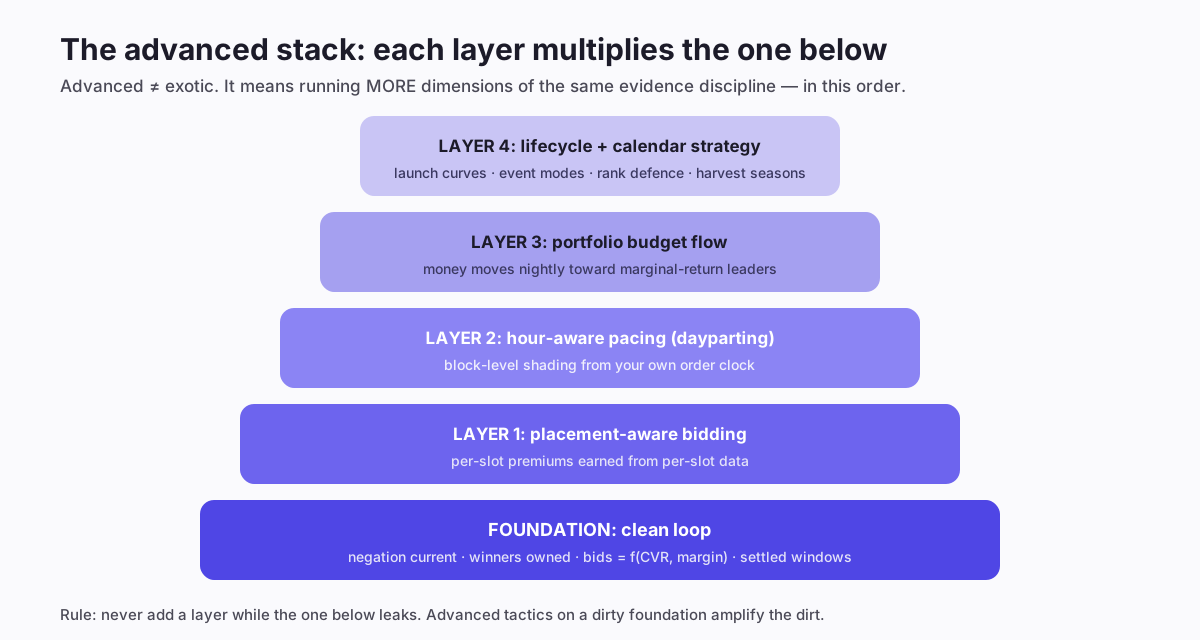
Read the stack bottom-up, because its one iron rule is build-order: never add a layer while the one below leaks. Placement premiums computed on top of un-negated waste amplify the waste; dayparting an account whose bids ignore conversion rates shades garbage by the hour; portfolio flow across dirty campaigns ships budget to whoever leaks most convincingly. The foundation — the loop running clean, bids on the formula, judgments on settled windows — isn't the beginner version of PPC. It's the load-bearing floor of every advanced move, and in measured accounts (a tenth of spend on proven waste) it's usually the layer that's actually missing when someone asks for advanced tactics.
Layer 1: placement-aware bidding
The first dimension beyond per-term bids: the same term performs differently by slot, and modifiers price the difference. The full mechanics live in the placements guide; the advanced-stack summary:
- The rule: a slot premium is earned when its CVR premium meets its CPC premium — per campaign, from its own placement report, on 60-90 settled days.
- The discipline: effective-bid awareness. Modifiers stack multiplicatively with dynamic bidding; advanced operators audit what they're actually bidding per slot, not what they typed.
- The payoff shape: a few points of blended ACoS, concentrated on your biggest terms — which is why layer 1 pairs naturally with SKC isolation for heroes, whose per-term placement data makes the premiums precise.
Layer 2: hour-aware pacing
The second dimension: time. Conversion moves by hour while flat bids pay the average — the dayparting guide covers the mechanism and the four failure modes. Stack-level notes:
- Blocks before hours: four behavioural blocks shaded ±15-25% capture most of the value at a fraction of the fragility; 24-slot precision needs infrastructure-grade data (Marketing Stream) that spreadsheets don't have.
- The interaction with layer 1: hour shading multiplies onto placement-modified bids — the stack's compounding is also its risk surface, and each layer added means auditing the product of all layers against break-even, not each layer alone.
- The honest gate: low-volume products can't measure hourly differences faster than they drift. Layer 2 is for accounts whose foundation throws off enough data to slice.
Layer 3: portfolio budget flow
The layer that changes the question. Campaign-level thinking asks "is this campaign good?"; portfolio thinking asks "where does the next dollar earn most?" — and moves a fixed account budget weekly toward the answer.
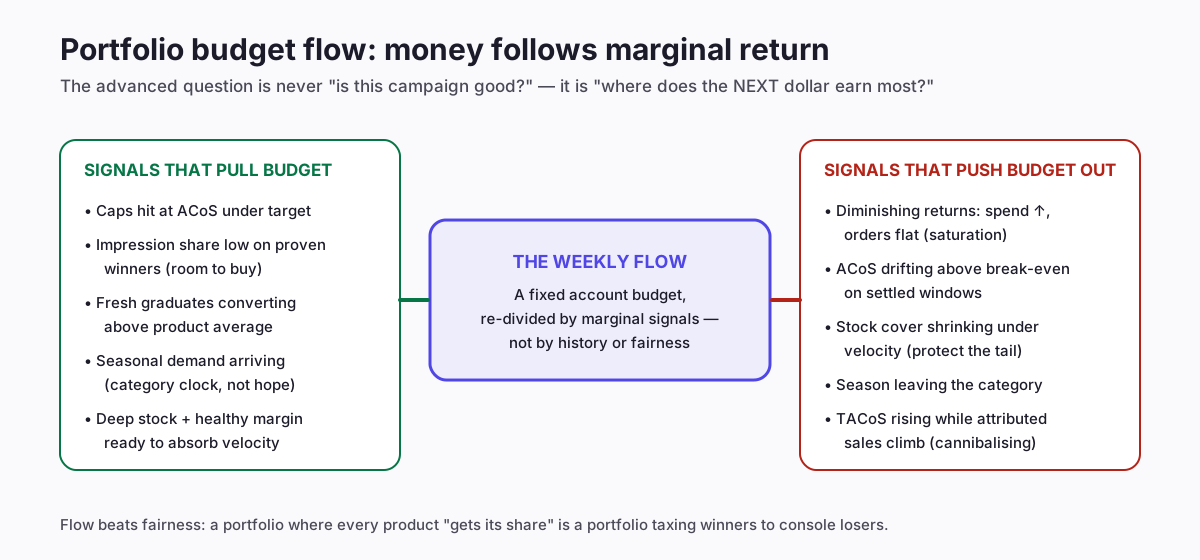
Two portfolio moves that campaign-level thinking never makes:
- Deliberate starvation of the mediocre. A campaign at exactly break-even, stable for months, is consuming budget whose marginal alternative (a capped winner, a converting graduate) earns more. Fairness is not an allocation strategy — the tier logic applies even when total budget isn't shrinking.
- Stock- and margin-weighted flow: the next dollar's value depends on what it accelerates — velocity on a deep-stock, high-margin product compounds (rank, reviews, more velocity); the same velocity on thin stock buys your own stockout. Portfolio flow reads inventory and margin as bid inputs, not as someone else's spreadsheet.
Layer 4: lifecycle and calendar strategy
The top layer runs different modes over the same machine, because the right strategy depends on where each product is and what the calendar is doing:
- Launch mode: deliberate above-break-even spend buying rank and data, with an end date and a graduation plan (the inversion). Advanced isn't avoiding launch losses — it's pricing them as investment and collecting the return on schedule.
- Defence mode: mature winners shift objective from growth to moat — brand-term coverage, SB defence, page-piracy denial — where the metric is share held per dollar, not ACoS.
- Event modes: the Q4 playbooks as regime switches: lead-in calibration, surge operation, harvest — each suspending parts of normal logic on schedule.
- Harvest mode: declining products run for cash — bids stepped to maximum-margin position, discovery off, budget flowing out to the portfolio. Knowing when a product enters harvest is a true-profit read, not a sentiment.
The layer's discipline: modes are declared, with dates and exit criteria. An account where every product's mode is written down can be operated; an account where modes are vibes can only be reacted to.
The boring superpower: measurement discipline at every layer
Every layer above shares one dependency that separates compounding operators from busy ones:
- One change-set per settled window, per surface. Advanced accounts change more dimensions, which multiplies the temptation to change several at once — and untangling a bid step + modifier change + budget shift made the same week is impossible. Serialise per surface; the written-outputs habit is the mechanism.
- Displacement tests over dashboard reads for anything whose attribution flatters (SB, retargeting, defence spend): pause, watch blended results on settled weeks, conclude. The advanced account budget includes a small standing allowance for deliberate experiments — knowing is cheaper than guessing at scale.
- TACoS as the portfolio referee: every layer can look locally excellent while cannibalising organically; the account-level trend is the number that can't be gamed by any single dashboard.
- Honest attribution of your own wins: when ACoS improves the same month you shipped three changes and a season turned, "what worked" is a research question, not a feeling. Write the hypothesis before the change; grade it after.
Advanced anti-patterns: what the hacks crowd gets wrong
Filed for recognition, since they're marketed relentlessly:
- Loophole launches (search-find-buy schemes, rebate ranking) — policy-violating, increasingly detected, and structurally temporary: rank bought without conversion evidence decays the moment the scheme stops.
- Bid-jamming rituals — hourly manual bid changes chasing auction "momentum". The auction has no momentum to chase; unsettled data has noise to react to, and reacting to noise at higher frequency is just noise with dedication (event weeks especially).
- Copy-the-leader targeting — scraping a competitor's keywords and matching their moves. Their margin structure, CVR and strategy aren't yours; their bids are wrong for you by construction.
- Complexity as competence — forty-campaign architectures, modifier lattices, rule pyramids that no one can audit. The structure test ("what decision does this boundary serve?") kills most of it. Advanced accounts are usually simpler than intermediate ones, because every surviving element earns its audit cost.
A quarter on the stack: what compounding looks like
The stack's promise is compounding, so here's its honest shape across one composite quarter, starting from a clean foundation:
Month 1 — layer 1 lands. Placement audits across eight campaigns find three earned premiums and two fossil modifiers; corrections step in. Blended ACoS improves ~1.5 points. Unspectacular — but the changes were serialised and logged, so the gain is attributable, which matters in month three.
Month 2 — layers 2-3 layer on. Block-level dayparting ships on the four highest-volume products (the only ones whose data supports it); portfolio flow moves 12% of budget from two break-even-stable campaigns to a capped winner and a converting graduate. Orders rise ~6% on flat spend. The dayparting effect alone is barely measurable — on top of clean placements and flowing budget, the account's whole surface is now priced closer to its true economics.
Month 3 — the compounding shows. The capped winner, funded and hour-shaded, gains rank; its organic share rises; TACoS drifts down 1.8 points while ACoS holds. A declared harvest mode on one declining product releases budget that funds a launch's deliberate above-break-even month — priced, dated, logged.
Total quarter: high-single-digit profit improvement on flat spend, every point of it traceable to a logged decision. That traceability — not any single tactic — is what makes quarter two better than quarter one. The stack compounds because its evidence does.
Running the stack: the capacity question
Count the honest workload: the foundation loop weekly, placement audits quarterly, dayparting curves monthly, portfolio flow weekly, modes per product with dates, one experiment always in flight, every change serialised and written down. For a ten-product account that's a real part-time job performed to laboratory standards — which is why most human-run accounts plateau at the foundation (on good weeks), and why the stack is where automation stops being a convenience and becomes the difference between knowing the layers exist and actually running them.
AIAdKing's nightly cycle runs the stack as described: foundation loop nightly, placement and hour adjustments from each surface's own settled data, budget flowing to marginal-return signals with stock and margin as inputs, event and lifecycle modes switched on schedule — every action logged with its layer and reason, auditable in shadow mode. The flat fee covers all layers; the discipline is structural rather than aspirational. That, honestly, is the most advanced strategy on this page.