
Map the symptom before touching anything
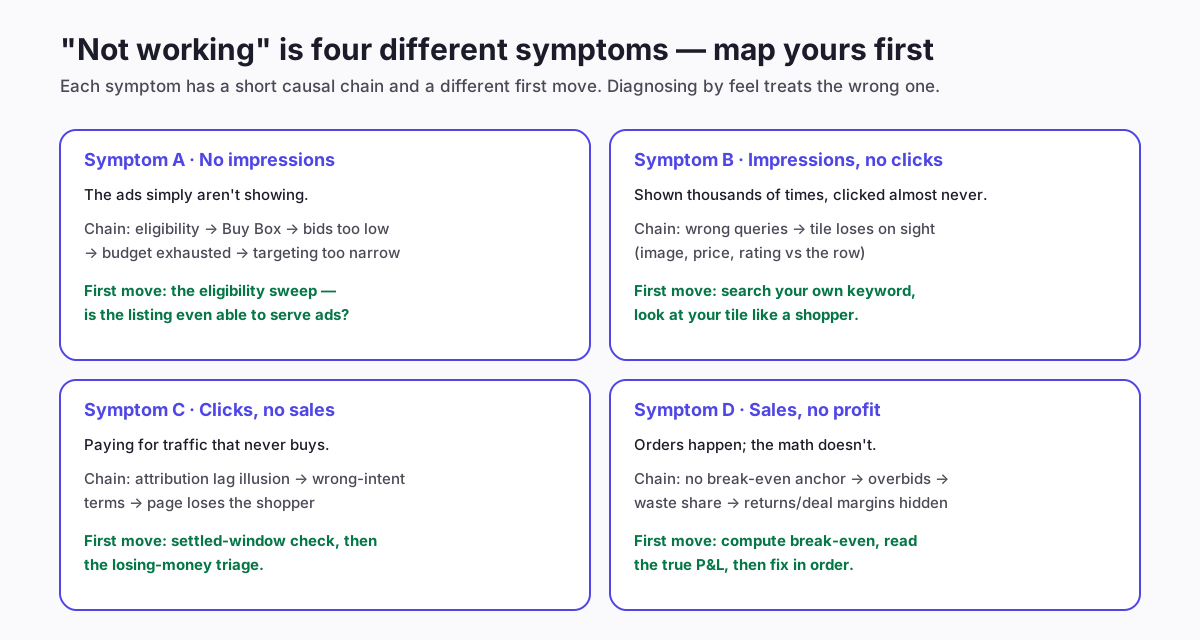
Ten seconds of dashboard reading assigns your case: impressions near zero → A; impressions healthy, CTR dismal → B; clicks accumulating, orders absent → C; orders flowing, money shrinking → D. Two cases can coexist (a B on some campaigns, a D on others) — diagnose per campaign, not per account, because the symptom map is really a funnel map: A is "can't enter the auction", B is "lose at the tile", C is "lose at the page", D is "win unprofitably". Each stage's fix lives at that stage; bids only genuinely own part of A and part of D, which is why bid-first troubleshooting fails three times out of four.
Symptom A: no impressions — the eligibility chain
Ads that don't serve fail somewhere on a short, ordered chain — check it top to bottom and stop at the first break:
- Is the ad eligible at all? Suppressed or inactive listing, out of stock, or — the silent killer — no Buy Box: Sponsored Products only serve while you hold it. This step catches the plurality of real cases, and it's invisible in the ads console.
- Is the campaign live and funded? Paused states, end dates someone set for an old event, or a budget exhausted by early afternoon — "no impressions" that's actually "no impressions since 1pm".
- Can the bid enter the auction? New accounts especially: a bid far below the category's going rate buys literal silence. Nudge upward in steps toward your formula ceiling — silence at your ceiling means this term is unaffordable at your current conversion, which is information, not failure.
- Is targeting too narrow? Ultra-long-tail exacts with no search volume, or an over-negated campaign (a phrase negative swallowing everything — audit negatives when impressions died after a cleanup session).
- Is it just new? Fresh campaigns ramp over days as relevance establishes. Days of quiet ≠ broken (the first-30-days shape).
Symptom B: impressions but no clicks — the tile contest
Thousands of impressions with a dismal CTR means your ad enters auctions and loses the only vote that matters at that stage: the shopper's glance. Two causes, one test:
The test: search your main keyword in an incognito window and find your tile in the results. Look at the row like a buyer for five seconds. Almost always the problem announces itself:
- Wrong auctions: your ad appears on queries whose intent your product doesn't match — broad/auto wander serving you into rows where you look irrelevant. The fix is the negation pass and tighter match-type fencing, not creative agony.
- Losing the row on sight: right auctions, weaker tile — main image less legible than neighbours at thumbnail size, price visibly above the row's cluster, rating count an order of magnitude below the competition, no badge in a badge-heavy row. These are listing-side fixes; during deal weeks, expect full-price CTRs to sag against badge walls regardless — that's calendar, not failure.
What's not on the list: raising bids. More impressions of a tile that loses on sight buys more losing, faster.
Symptom C: clicks but no sales — check the clock first
The most misdiagnosed symptom, because its most common cause isn't a cause at all:
- The attribution illusion. Orders credit to clicks days late; a campaign read the morning after launch (or the morning after any change) shows clicks with their orders still in transit. Before any conclusion: is this reading from a settled window? Week-one "clicks but no sales" panic is the single most common false alarm in Amazon PPC.
- Wrong-intent clicks: settled and still orderless usually means the traffic was never going to buy — accessory-seekers clicking a main product, bargain-hunters clicking premium, adjacent-category wanderers. The search-term report names them; the triage convicts them on evidence thresholds.
- The page loses the shopper: right terms, settled data, weak conversion everywhere — price against the page, image stack, review count, unanswered objections in the bullets. Ads delivered witnesses; the listing lost the case. This is the fix-the-page verdict, and holding bids steady during the repair (rather than cutting) keeps the evidence flowing.
Symptom D: sales but no profit — the arithmetic chain
Orders arrive, the bank disagrees. The chain, in fix-order:
- No break-even anchor: if the target ACoS is folklore rather than computed margin, "unprofitable" may be false (or true) — nobody knows. Two minutes per product ends the guessing.
- The waste share: the measured tenth of spend on proven non-converters taxes every real order's margin.
- Bids above the formula: converting terms overpaying per click — profitable-looking activity that donates margin at scale (the arithmetic).
- The hidden deductions: returns on ad orders and deal-week margins — the true-P&L layer that turns dashboard-profitable into bank-neutral.
Work the chain top-down: each step's fix makes the next step's numbers readable, and the full recovery sequence is the lower-ACoS playbook with its triage already done.
The expectation timeline: is it broken, or just young?
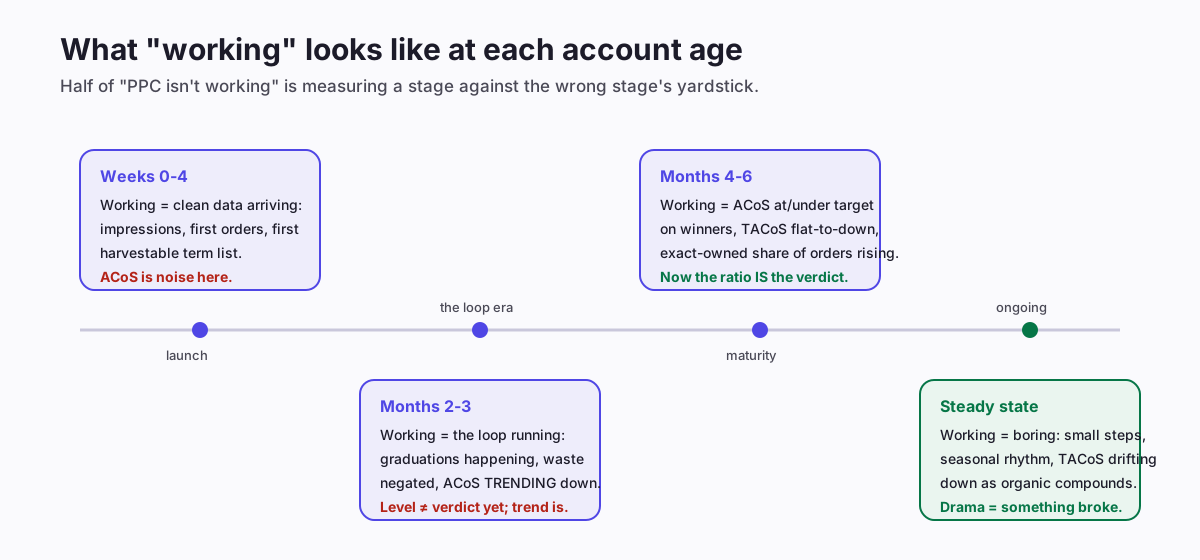
The timeline's uncomfortable corollary: "working" changes meaning as the account ages, and most "not working" verdicts apply a later stage's yardstick to an earlier stage's account. A three-week-old campaign with noisy ACoS and a growing term list is succeeding at its stage; a year-old account with the same profile is genuinely broken. Before any fix from the sections above, date your account honestly — and if it's young, the fix may be four more weeks of the standard loop, executed boringly.
The reverse error exists too: mature accounts coasting on "we're still learning" a year in. The tell is the trend — a young account trends (noisily) toward its targets; a stuck account circles. Flat-for-a-quarter is a verdict.
The one-hour full diagnostic, in order
When you want the complete sweep rather than a single symptom's chain:
- Minutes 0-10 — eligibility and vitals: Buy Box held, listings live, campaigns funded and un-expired, no suppressions. (Symptom A's chain, run as a checklist.)
- Minutes 10-20 — the tile test on your top three keywords, incognito. (Symptom B.)
- Minutes 20-35 — settled-window read: real ACoS per campaign against computed break-evens; flag C-shaped campaigns (clicks, no settled orders) and D-shaped ones (orders above break-even).
- Minutes 35-50 — the two account leaks: waste share from the search-term report; top-20 bid audit against the formula.
- Minutes 50-60 — write the verdict per campaign: symptom letter, first move, review date. The written verdict is the difference between diagnosis and mood.
Most accounts leave the hour with two or three named symptoms and a fix order — which is the entire point: "not working" is unfixable, but "B on the hero, D on the accessories" is a to-do list.
Keeping it working: the maintenance truth
Every symptom on this page is something that develops — Buy Box slips, tiles age against fresher competition, wander accumulates, bids drift off their formula as CVRs move. An account diagnosed clean today re-develops symptoms at the speed its maintenance loop skips weeks. That's the honest close of every troubleshooting guide: the fix for "not working" is rarely one change, and always a running system.
AIAdKing's nightly cycle is that system with the skipping removed: eligibility and Buy Box watched continuously, waste negated on thresholds, bids re-derived from settled evidence, budgets paced before winners go dark — and every symptom this page maps surfaces as a flagged cause with its evidence instead of a vague underperformance. Shadow mode shows each proposed fix before it applies; the flat fee stays flat. The free trial is, practically speaking, this page's one-hour diagnostic run nightly, forever.