
The comparison that misleads everybody
The first thing to fix is the denominator. Comparing this week to festival week guarantees an alarming number, because a peak is by definition not the baseline — that is what makes it a peak. Yet it is the comparison every dashboard invites, because it is the most recent data on screen.
Three comparisons that actually carry information:
- This November against last November. The only comparison that can prove a problem, because it holds seasonality constant. Flat or up year-on-year means the decline is the calendar, not you.
- This week against the quiet week before the season started. Late September, pre-wave, is a fair read of your underlying demand. Landing near it is normal; landing well below it is a signal.
- This week against the trailing twelve-month median, per product. Blunt but honest, and it exposes the specific SKU carrying the damage rather than an account-level average that hides it.
Set the comparison before you look at the number. Choosing a denominator after seeing a result you dislike is how sellers talk themselves into changes that make things worse.
Four readings that tell seasonality from breakage
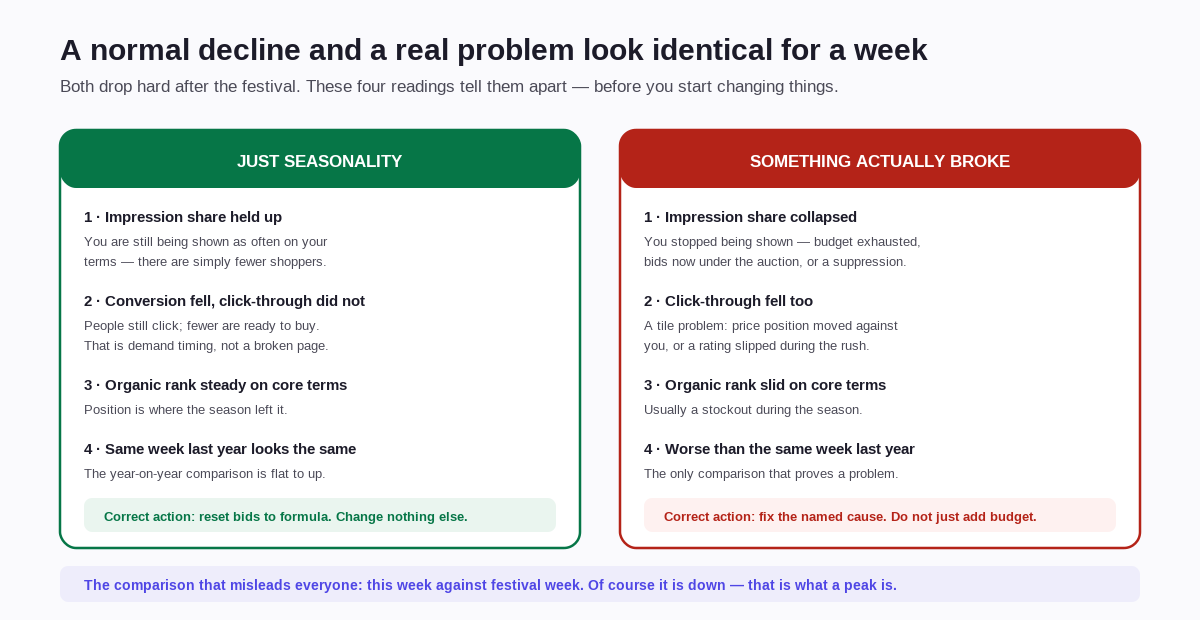
Run all four before touching anything — each one isolates a different cause, and the pattern across them names the problem:
- Impression share. Still being shown as often? Then there are simply fewer shoppers, which is seasonality. Collapsed? Then you stopped appearing, and the cause is mechanical: a budget exhausted, bids now under a shifted auction, or a listing suppression.
- Click-through versus conversion. Conversion falling while click-through holds is demand timing — people still click, fewer are ready to buy. Both falling points at the tile: price position moved against you, or a rating slipped during the rush.
- Organic rank on core terms. Steady rank means the season did not cost you position. A slide almost always traces to a stockout during the waves, and that is a real problem with a real recovery cost.
- Year-on-year. The tiebreaker. Down against last November, with the readings above clean, means something changed in your competitive position rather than in the calendar.
If it is seasonality: do almost nothing
This is the hardest advice to follow and the most valuable. When the four readings come back clean, the correct response is a reset to normal economics and then patience:
- Finish the step-down. Every bid raised for a peak returns to its formula level. If this has not happened yet, it is the one genuinely urgent task on the list — peak bids against post-peak conversion rates lose money on every click.
- Do not cut winners to "save money". A seasonal dip is not a signal to defund products that work. Cutting a ranked product in the quiet season surrenders position that costs multiples to rebuild when demand returns.
- Do not restructure. The urge to rebuild campaigns during a slow fortnight is strong and almost always wrong; you would be throwing away measured history to feel productive.
- Do not chase the dip with discounts. Post-festival shoppers are fewer, not more price-sensitive. Discounting into thin demand trains buyers to wait and damages the margin you just earned.
The framing that helps: the festival season pulled demand forward. Some of November was spent in October. That is not lost revenue, it is relocated revenue — and reacting to it as a crisis is how a good season gets partly undone in its aftermath.
If something broke: the usual four causes
When the readings point at a real problem, it is almost always one of these — in descending order of frequency:
- A stockout during the season cost organic position. The most common and most expensive. Recovery is a deliberate mini-push on the affected terms once stock is reliable, not a general budget increase; the rank mechanics are earned back the same way they were earned first.
- A rating slipped. Festival volume means festival returns and reviews, and a dip from 4.4 to 4.1 quietly changes conversion on every impression. It shows up as click-through and conversion both falling, and no amount of bidding fixes it.
- Price position moved. Competitors who discounted for the season sometimes stay discounted. If your relative position changed, your conversion rate changed with it — and that is a pricing decision, not an ads one.
- The account is still spending at peak settings. Worth checking twice, because it is invisible in revenue and obvious in margin: spend at peak levels against normal conversion shows up as an ACoS that quietly doubled.
Fix the named cause. The instinct to respond to any decline by adding budget is how a listing problem becomes an expensive listing problem.
The reset: two weeks that set up next year
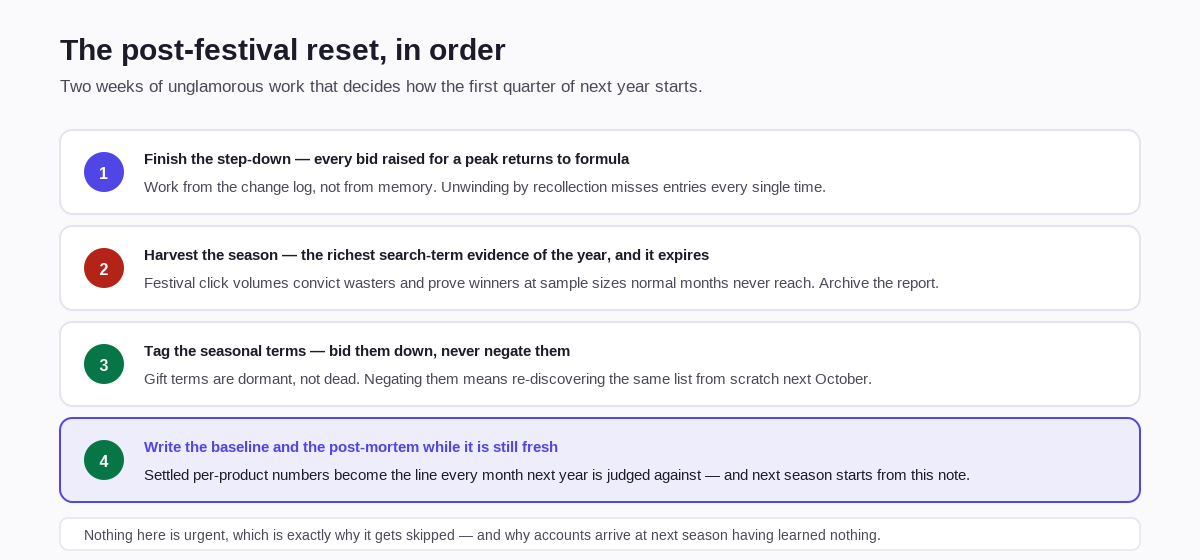
Step 2 is the one worth arguing for. Festival weeks generate click volumes that normal months never reach, which means terms reach conviction thresholds — enough clicks with zero orders to be genuinely proven wasteful — at sample sizes you will not see again until next season. Roughly one dollar in nine leaks to non-converting search terms across accounts we audit, and the post-festival window is when that leak is cheapest to close and easiest to prove.
It also expires. Amazon retains a limited window of search-term history, so a report not downloaded is data permanently gone. A single archived export in mid-November is the cheapest insurance in the annual calendar, and it is what makes next year's run-up start from a validated keyword list instead of guesswork.
Seasonal terms are dormant, not dead
Step 3 deserves its own section because the mistake is so common and so silently costly. Gift and occasion terms that converted beautifully in early November will convert at nearly zero for the following ten months. The tempting move is to negate them. Do not.
Negation is memoryless. Negate the gifting list in November and next October you begin by rediscovering it — paying for the same education, at event prices, with a season's head start lost. Bids have a dial; negatives have a switch. Use the dial:
- Bid the seasonal terms down to embers rather than removing them, so their history stays attached and they can be re-bid on a date.
- Tag them in the log as seasonal, with the dates they performed. This note is the single most useful artefact next season.
- Keep the campaigns intact. A paused campaign loses nothing, but a deleted one loses its measured history — and history is the thing that makes next year cheaper.
The same logic covers convictions generally — the evidence standard for cutting spend wants proof that a term fails in the conditions where it is supposed to work, and an off-season month is not that evidence.
What the quiet weeks are actually good for
The post-festival fortnight is the cheapest experimental window of the year — low competition, low CPCs, low stakes — which makes it the right time for exactly the work that is reckless during a peak:
- Listing improvements. Change the page now, when a mid-flight relevance reset costs nothing, rather than in October when it costs the season.
- Structure changes. New campaigns need a settling window, and this is a fortnight where a settling window is free.
- Careful experiments. Test a match type, a placement adjustment, a price point — with enough time for a settled read before the next demand event.
- The profit reconciliation. Festival months carry unusual fees, returns and storage. A true-margin pass now tells you which products actually made money at peak, which is frequently not the ones that looked busiest.
That last one reframes the whole season. Revenue rankings during a festival are a poor guide to what to fund next year; margin rankings after fees and returns are the honest list — and November is when you can still build it while the numbers are fresh.
Writing the post-mortem while it is fresh
Step 4, and the one that compounds. A short written record now is worth more next September than any amount of remembering:
- What the waves actually did — which peaks were big, which were quieter than expected, how spend landed against the plan.
- Where the money went — per product, after fees and returns, not by revenue.
- What ran out — the stockouts, when they hit, and what they cost in position.
- What you would change — written now, while the irritation is specific, rather than reconstructed in ten months as a vague feeling.
- The baseline numbers — settled per-product ACoS, conversion and TACoS for a normal post-season week. This is the line the rest of the year gets judged against, and having it stops next July's ordinary week from reading as a crisis.
None of this is urgent, which is exactly why it gets skipped — and why so many accounts arrive at each festival season having learned nothing from the last one.
Making the reset happen on its own
Read the list again and notice its character: the step-down, the harvest, the seasonal tagging, the baseline. Every item is mechanical, deadline-bound, and completely unexciting — which is precisely the profile of work that does not happen in the exhausted fortnight after the biggest weeks of the year. That is not a discipline failure; it is predictable, and the fix is to not rely on willpower for it.
AIAdKing runs the mechanical half continuously: bids tracking each term's own settled conversion rate (so the step-down is simply what happens as the numbers fall, not a task someone has to remember), negation on evidence thresholds, and the true-profit view per product with fees and returns already assembled — all logged, at a flat fee. What stays yours is the judgement: the post-mortem, the pricing calls, what to fund next season. Answer the four readings honestly, resist the urge to fix a calendar, and spend the quiet weeks making next October cheaper.