
The fee schedules, honestly stated
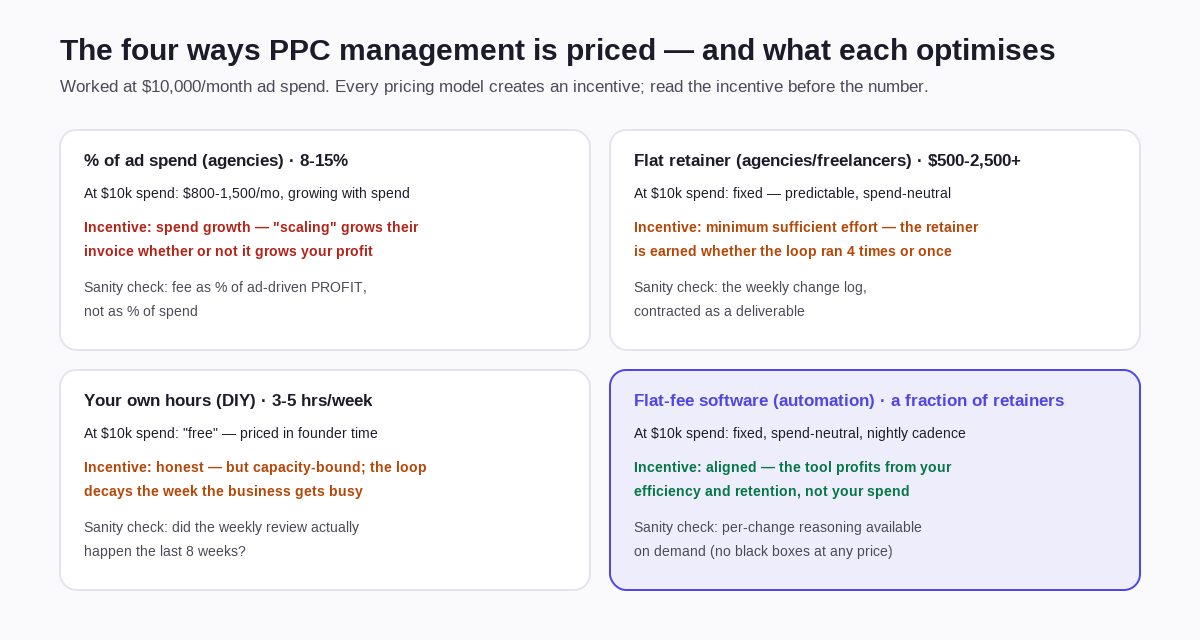
Ranges, as the market actually quotes them:
- Agencies: commonly 8-15% of ad spend with minimums, or retainers from roughly $1,000 to $2,500+ for small-to-mid accounts (enterprise engagements go far higher). The agency-math guide unbundles what that buys.
- Freelancers: typically $500-1,500/month or hourly — cheaper, wildly variable, and single-point-of-failure by construction.
- Software: flat monthly fees from tens to hundreds of dollars depending on tier; percentage-of-spend tools exist and import the agency incentive wedge at software prices.
- DIY: 3-5 competent hours weekly, priced in founder time — the most honest model and the most capacity-fragile.
Read the incentive column before the price column: every model optimises something, and what it optimises will happen to your account whether or not it was what you wanted.
The leak: the cost nobody invoices
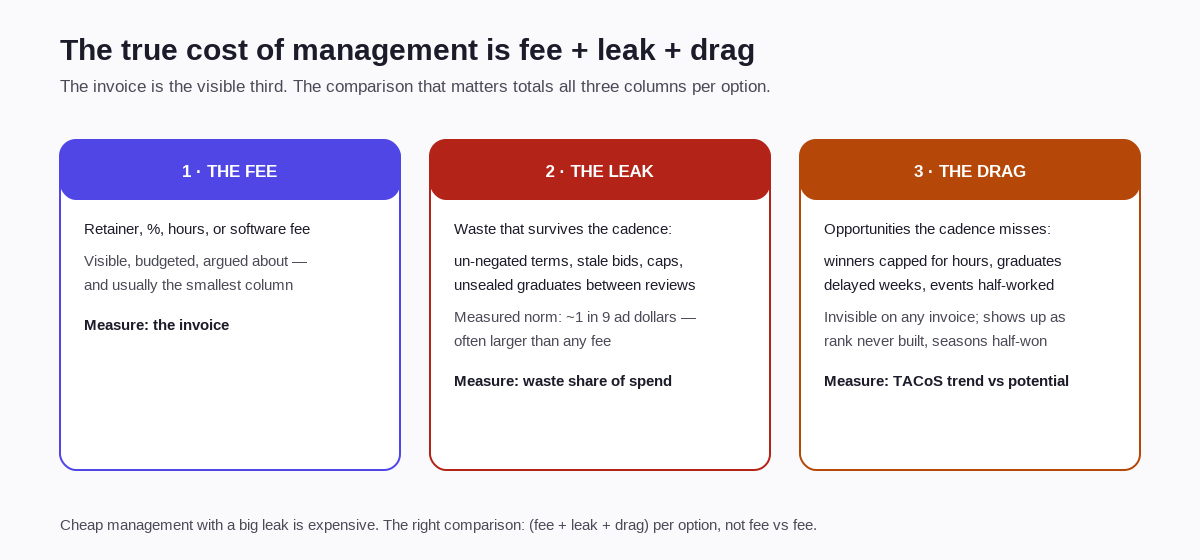
The leak is waste that survives whatever cadence your management model runs: search terms spending past their conviction threshold, bids stale against drifted conversion rates, unsealed graduates double-paying, winners dark on budget caps between reviews. Its measured baseline across live accounts: about one ad dollar in nine on already-convicted waste alone — at $10k monthly spend, roughly $1,100/month, or more than most management fees.
The leak's size is a direct function of cadence, which is why it belongs in the management-cost comparison: a weekly-touch agency leaves ~6 days of leak between reviews; a diligent DIY loop leaves the weeks life intervenes; nightly automation leaves overnight. Comparing a $1,200 agency against a $99 tool on fees alone, while one leaves a four-figure monthly leak and the other doesn't, is comparing the wrong column.
The drag: the invisible third
Harder to measure, just as real: the drag is compounding that didn't happen. A capped winner that stayed dark every afternoon for a month didn't just miss those orders — it missed the rank those orders fed, the reviews they'd have produced, the organic share they'd have built (the flywheel spinning slower). A graduate promoted three weeks late converted at discovery prices for three extra weeks. An event season half-worked is a Q4 that funded competitors' rank instead of yours.
Drag shows up in exactly one place: the TACoS trend versus what the account could have compounded. Its management-model dependence is the same cadence story — but with a twist: drag punishes slow positive action (raises, graduations, event preparation) where the leak punishes slow negative action (negations, cap fixes). Models that are merely defensive — rules that only ever cut — control the leak and maximise the drag. Ask any "we'll reduce your wasted spend" pitch what it does about the other direction.
Total cost of ownership: three worked profiles
The three-column math at $10k/month spend, composite but realistic:
Profile A — diligent DIY. Fee: $0 cash, ~16 founder-hours/month. Leak: low in disciplined months, spiking in busy ones — call it 5-9% of spend averaged ($500-900). Drag: moderate — human weekly cadence catches most raises a week late. True monthly cost: $500-900 + 16 hours, with high variance tracking the founder's calendar.
Profile B — mid-tier agency at 12%. Fee: $1,200. Leak: depends entirely on whether the loop actually runs — with real weekly execution, ~4-7% ($400-700); with cadence theatre, the full baseline ~11%. Drag: weekly-touch latency on raises and events. True monthly cost: $1,600-2,300, plus the wedge (the fee grows if they "scale" you).
Profile C — flat-fee nightly automation. Fee: a fraction of the retainer. Leak: structurally near-floor — thresholds fire nightly. Drag: near-floor for the same reason (raises and graduations fire as fast as cuts). True monthly cost: the fee, roughly alone — with the honest caveats that strategy stays human and inputs (margins) must be maintained.
The pattern generalises: as spend grows, fee differences grow linearly while leak-and-drag differences grow with them — which is why the model choice matters more, not less, at scale.
What "good management" costs to verify (any model)
Whatever you pay, verification is the same short audit — run it quarterly on your own account regardless of who manages it:
- Waste share: the search-term report, 60 days, share of spend on 15+ click / zero-order terms. Above ~5% = the leak is being managed in theory.
- Cap audit: how many campaign-days last month ended with a profitable campaign dark on budget? Each one is drag with a timestamp.
- Bid staleness: sample ten top targets — do current bids track their settled CVRs through the formula, or their history?
- Change-log existence: can whoever manages the account show last week's changes with reasons, in minutes? (The universal question — for agencies, tools and yourself.)
- TACoS trend: flat-to-down = compounding happening; up = paying for the same sales twice.
The audit prices the invisible columns. An account that fails it is expensive at any fee; one that passes is cheap at most of them.
Cost by seller stage: what to pay when
The right spend on management follows account maturity, not ambition:
- Under ~$2k/month spend: fees must be near-zero — every model's minimum charge is a huge percentage of a small machine. DIY the loop (it's also the education), or flat-fee software at the low tier. Agencies at this size are a category error, theirs and yours.
- $2k-15k/month: the automation sweet spot — the leak-and-drag columns now dwarf software fees, while agency retainers still eat a painful share of ad-driven profit. Buy strategy by the hour when a launch or format question genuinely needs it.
- $15k+/month with breadth: the agency's home turf opens (DSP, off-Amazon, creative programs) — as a strategy layer. The execution layer's economics don't reverse at scale; they intensify, which is why larger accounts increasingly run automation under agency strategy rather than either alone.
- Any stage, seasonal: Q4 multiplies both leak and drag — the quarter where cadence gaps cost the most is the quarter to be honest about yours.
Negotiating and structuring: getting more per fee dollar
Whichever model you land on, structure beats haggling:
- With agencies: contract the weekly change log as a deliverable; prefer flat retainers over percentages (kills the wedge); scope the engagement to the strategy slice if execution runs on systems; pre-agree the exit and data handover. A smaller fee for a named scope beats a bigger fee for "holistic management".
- With freelancers: same log, plus redundancy — the single-point-of-failure risk is the real price; keep credentials architecture clean (proper permissions, never shared passwords) so transitions cost days, not quarters.
- With software: pay for reasoning, not dashboards — the 20-minute evaluation separates them; prefer flat fees; and use preview modes as the free audit they are.
- With yourself: timebox the loop (the 25-minute routine), calendar it like a client meeting, and track your own skipped weeks honestly — the DIY fee is only zero when the work happens.
The comparison, compressed
The whole guide in one procedure: for each option you're weighing, write three numbers — the fee, the leak you'd expect at that cadence (audit your current one as the baseline), and an honest guess at the drag — and compare totals, not invoices. At most spend levels that procedure lands in the same place: execution on nightly systems, strategy bought as needed, verification quarterly regardless.
AIAdKing is priced for exactly that structure: a flat monthly fee that doesn't scale with your spend, the nightly cadence that holds leak and drag at the floor, and per-change reasoning that makes the quarterly audit a five-minute read instead of an investigation. The free trial needs no card — which makes the three-column comparison against your current setup genuinely free to run.