
The reframe: you're not replacing expertise, you're replacing cadence
Sellers stay with mediocre agencies for one reason: the fear that some special knowledge leaves with them. Unbundle what an agency's execution slice actually does — read reports, negate wasters, graduate winners, step bids, pace budgets — and the knowledge turns out to be this site's core loop, documented everywhere, learnable in a month. What the agency really sells is cadence: the loop performed on schedule by someone whose calendar can't bump it.
That reframe changes the solo question from "do I know enough?" (yes, or you will within weeks) to "what makes my cadence bump-proof?" — which is a systems question with systems answers: calendared rituals, written outputs, and automation for the parts that decay fastest. The agency-math guide covers whether to leave; this one covers how to run what comes after.
The operating system: four rituals
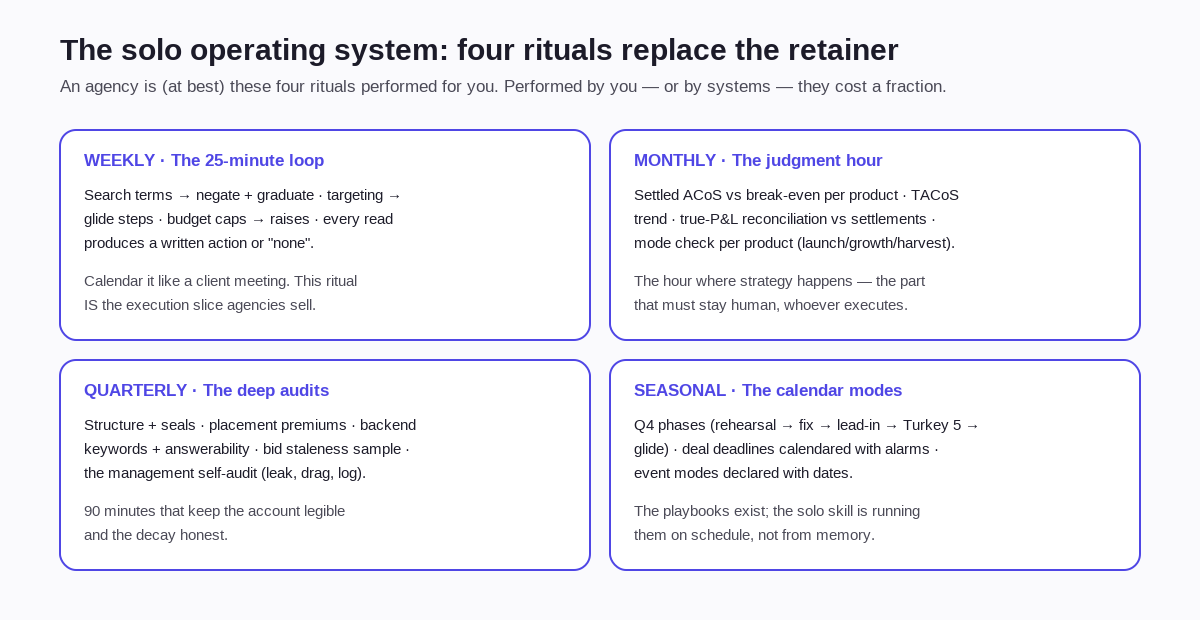
The design principle behind the split: each ritual runs at the speed its decisions decay. Search-term waste accumulates weekly, so negation is weekly. Strategy questions (modes, margins, whether ads are growing the business) move monthly. Structure, placements and content rot quarterly. And the calendar (deal deadlines, Q4 phases) runs on its own schedule regardless of yours. Mixing the speeds — doing strategy weekly, negation quarterly — produces the classic solo pathologies: over-trading the noise while the leaks compound.
The weekly loop, minute by minute
The ritual that replaces the retainer's core, timed honestly (the full walkthrough is the reports routine):
- Minutes 0-8 — search terms, 60 days, by spend: negate convicted wasters (15+ clicks, zero orders, plausibly relevant), negate irrelevants on sight, graduate converters to exact with seals, list the watch-pile.
- Minutes 8-14 — targeting on settled windows: glide steps up for starved winners, down for over-priced targets, nothing for the noise-band majority.
- Minutes 14-18 — budget caps: which profitable campaigns went dark, when, raise accordingly. The cap-out check is the solo seller's highest-value four minutes.
- Minutes 18-25 — write the outputs: every action (or explicit "none") into the running log. The log is your agency deck, decision memory and quarterly self-audit input in one document.
Two rules make it bump-proof: it's calendared at a fixed time (treat it as a client meeting — you're the client), and a skipped week is logged as skipped — because the honest count of skips is the data that eventually decides the automation question.
The monthly judgment hour
The hour that must stay human under every management model:
- Settled ACoS vs break-even, per product — with break-evens refreshed if price or costs moved (two minutes each).
- TACoS trend — the growth referee: down = compounding, flat = efficiency only, up = paying twice for the same sales.
- True-P&L reconciliation against settlement data — returns and deal margins included, per the true-cost layer. Dashboard-profitable and bank-profitable diverge quietly; monthly is the honest catch cadence.
- Mode check per product: launch, growth, defence or harvest — declared, dated, with the exit criteria written down. The month a product's mode changes is the month its whole treatment changes.
- One experiment reviewed or started: a displacement test, a price test, a format test — the standing habit that keeps the account learning.
Output: a one-page monthly memo to yourself. Twelve of them are a better annual review than most agencies deliver.
The tools question, answered honestly
Solo doesn't mean unassisted, and the tool decision follows the same logic as everything else — what does each layer cost versus what it saves:
- Spreadsheets + bulk files (free): genuinely workable for small catalogs with reliable discipline — the build-it-yourself path, with its known ceiling: cadence still depends on you, and granularity (hours, placements) stays out of reach.
- Flat-fee automation: the weekly loop's mechanical majority — negation thresholds, graduations with seals, bid derivation, cap protection — run nightly instead of when remembered. The economics against agency retainers are covered in the cost guide; against your own time, the question is what your 16 monthly hours are worth.
- What no tool replaces: the monthly judgment hour, the mode declarations, the experiments — strategy stays yours. A tool pitching otherwise is selling past its honest boundaries.
The sequencing that works: run the loop manually for 4-8 weeks first (even alongside an outgoing agency) — the instincts it builds are what make you a competent supervisor of any tool, and shadow-mode automation during those weeks is a free second opinion on your own calls.
Leaving an agency cleanly
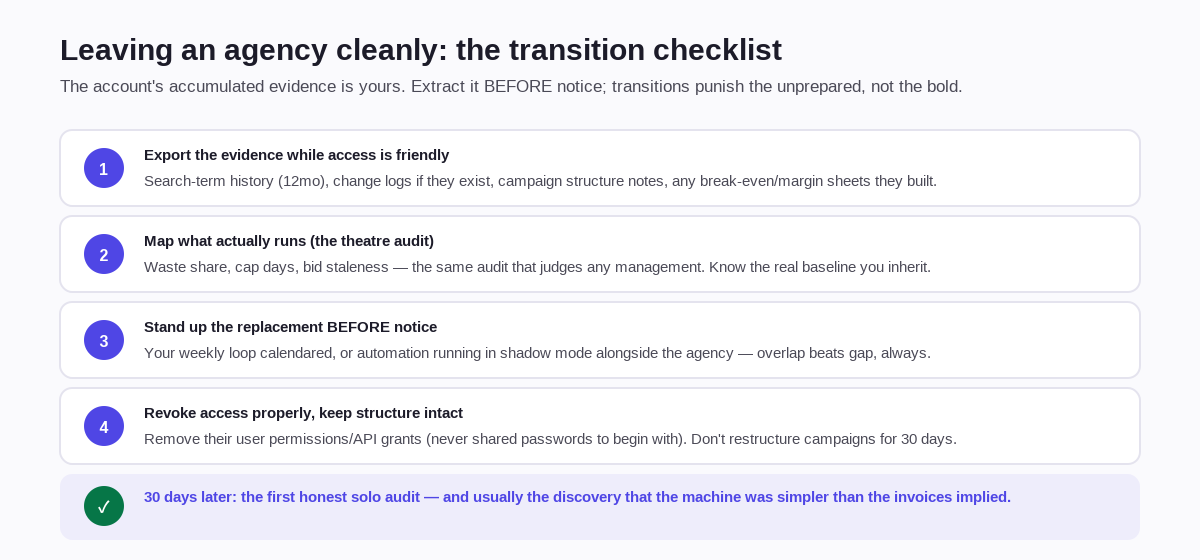
Notes on the sharp edges:
- Step 1 before step 3, both before notice. Access gets slower and moods get worse after notice; extract the account's evidence — search-term history, whatever change logs exist, margin sheets — while the relationship is warm.
- Expect the baseline audit to surprise you (either direction): some accounts arrive cleaner than the invoices suggested, many arrive with the leak intact under a polished deck. Either way, knowing the real starting point is what makes your first solo quarter measurable.
- The 30-day structure freeze matters: inherited structures encode decisions you don't understand yet, and the migration guide's incremental approach applies to inheriting from an agency exactly as it does to inheriting from your past self. Learn, then restructure.
- If credentials were ever shared as passwords rather than proper permissions, rotate everything on exit day — and file it as the reason the next arrangement uses revocable grants only.
The first 90 days solo: what to expect
Calibration for the transition quarter:
Month 1 feels like overcorrection. You'll check too often, trade too much, and re-learn the settled-window discipline the hard way once. The weekly log is the brake: if this week's entry is mostly reactions to unsettled numbers, the log itself tells you.
Month 2 is the leak harvest. The first full negation-and-seals pass on an inherited account usually finds meaningful waste (the measured baseline is a tenth of spend) — solo management's first win is typically cheaper than the agency month that preceded it, before any cleverness.
Month 3 is the judgment dividend. With clean data and two months of logs, the monthly hour starts producing real strategy: a mode change, a restructure decision, an experiment worth running. This is the point where most sellers report the surprising part — not that solo management works, but that the account finally feels legible, because every number now has a decision attached that they made and wrote down.
The honest failure mode to watch: weeks 6-10, when novelty fades and the calendar bumps its first ritual. That's the moment the skipped-week log earns its keep — and the moment to decide, on your own evidence, how much of the loop to hand to systems.
What solo sellers should still buy
Independence isn't abstinence. The purchases that make sense without a retainer:
- Strategy by the hour, on triggers: a launch architecture review, a DSP scoping call when spend justifies it, a quarterly second opinion on the monthly memos. Named problems, named experts, no bundle.
- Execution automation at a flat fee — the cadence layer, with the trust ladder (shadow mode first) as the adoption path and your own loop-literacy as the supervision skill.
- Your own education, deliberately: one deep topic per month from the cluster this post sits in — placements, dayparting, the advanced stack — matched to what the monthly memo says the account needs next.
AIAdKing was built as exactly this stack's execution layer: the nightly cycle running the weekly loop's mechanical majority with every action logged and reasoned, shadow mode for the supervision phase, and a flat fee that keeps the whole solo arithmetic honest. The free trial alongside your current setup — agency or manual — is the cheapest possible version of the transition this guide describes.