
Why Amazon ads is unusually good terrain for AI
Some domains flatter AI marketing more than they reward AI substance. Amazon PPC is the opposite — quietly ideal terrain, for three structural reasons:
- The decisions are numerous, small and evidence-shaped. Hundreds of targets × bids, budgets, negations, placements, hours — each a threshold judgment on data, none requiring taste. That's machine home turf; the human version decays into skipped weeks.
- The evidence arrives continuously and lags predictably. Attribution's settled-window structure (the lag every human misreads at least once) is exactly the kind of statistical discipline a system holds effortlessly and a tired seller abandons at 11pm.
- The cost of cadence gaps is measurable. In live accounts we measure, roughly one ad dollar in nine sits on already-convicted waste — not a knowledge failure, a repetition failure. Repetition is the one thing software never fails at.
The flip side frames the whole guide: because the terrain is good, the label is cheap — every rule-builder rebranded itself "AI" the year the word started selling. The jobs map below is how you tell substance from paint.
The four real jobs (and the two fakes)
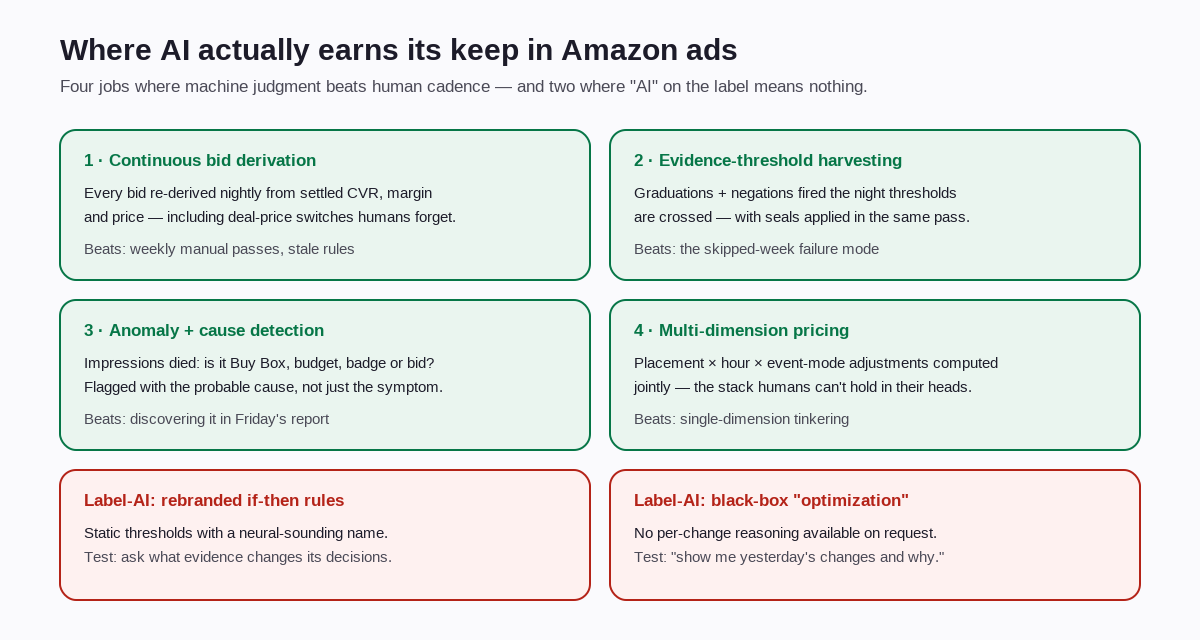
The dividing line between real and label is whether evidence changes the decisions. A rule ("if ACoS > 35%, cut 10%") executes a frozen judgment forever — including into the death spiral where the rule itself causes the condition it reacts to. A decision engine re-derives the judgment: this term's bid tonight is a function of its current settled CVR, your margin, tonight's price (deal-aware), its placement economics and the calendar mode — and next month, when those inputs have drifted, the same engine produces a different, still-correct answer.
The two-question audit for any vendor: "What evidence changes your system's decisions, and how often is it re-read?" and "Show me yesterday's changes on a real account, each with its reason." Real engines answer both in minutes. Label-AI reaches for a deck.
Job 1-2 in practice: derivation and harvesting
The first two jobs are the foundation loop, mechanised:
Continuous bid derivation runs the formula — price × margin × settled CVR — per target, per night, with the details humans systematically drop: deal-price switches during event windows (the margin-halving nobody recomputes at 11pm on deal eve), effective-bid awareness through modifier stacks, and glide-path stepping with sales guards rather than confident jumps. None of this is deep learning; all of it is judgment that stays correct because it's re-derived instead of remembered.
Evidence-threshold harvesting runs the graduation funnel the night thresholds are crossed: converters into exact with seals applied in the same pass, wasters negated at conviction (never before — the thin-data rule is a statistical discipline, and encoding it is precisely what stops the 2am panic-negation that kills future winners). The human version of this job is excellent in week one and mythical by month three; the machine version is identical every night, which is the entire point.
Job 3-4 in practice: causes and dimensions
The second pair is where "AI" stops being a synonym for "cron job" and earns the word:
Cause detection turns symptoms into diagnoses. "Impressions died" has a whole chain of causes — Buy Box loss, budget cap, dead badge, bid under the auction floor, suppressed listing — and the difference between a flag that says "campaign underdelivering" and one that says "campaign dark since 13:40, budget cap hit at healthy ACoS, raise recommended" is the difference between an alert and an answer. Cause detection requires joining ads data with listing state, stock, pricing and calendar — the cross-domain read no single console screen shows.
Multi-dimension pricing is the advanced stack computed jointly: placement premiums × hour blocks × event modes × portfolio flow interact multiplicatively, and humans either ignore the interactions (leaving money) or stack them blind (the effective-bid trap). Joint computation with guardrails is the one capability on this page that genuinely has no manual equivalent — not because humans are dumb, but because the arithmetic surface exceeds working memory at even modest scale.
What AI still can't do (and the vendors who say otherwise)
The boundaries, stated as plainly as the capabilities:
- It can't fix your listing. When clicks don't convert because of price, images or reviews, the honest AI response is to flag the conversion-side diagnosis and optimise within the ceiling that exists — not to pretend bids can raise it. (Symptom C is a page problem in every management model.)
- It can't choose your strategy. Launch above break-even or harvest for cash? Defend brand terms or spend into growth? These trade profit against position against risk — owner calls that a system should execute with discipline, not make by default.
- It can't conjure demand or judge taste. Creative, positioning, product selection — the strategy slice of the agency bundle stays human wherever it's bought.
- It can't outrun bad inputs. Wrong margins in, confidently wrong break-evens out — faster than a human would have managed. Input hygiene is the adopter's one non-delegable job.
A vendor claiming past these boundaries is selling the label. The real thing describes its edges without being cornered into them.
The trust ladder: adoption without betting the account
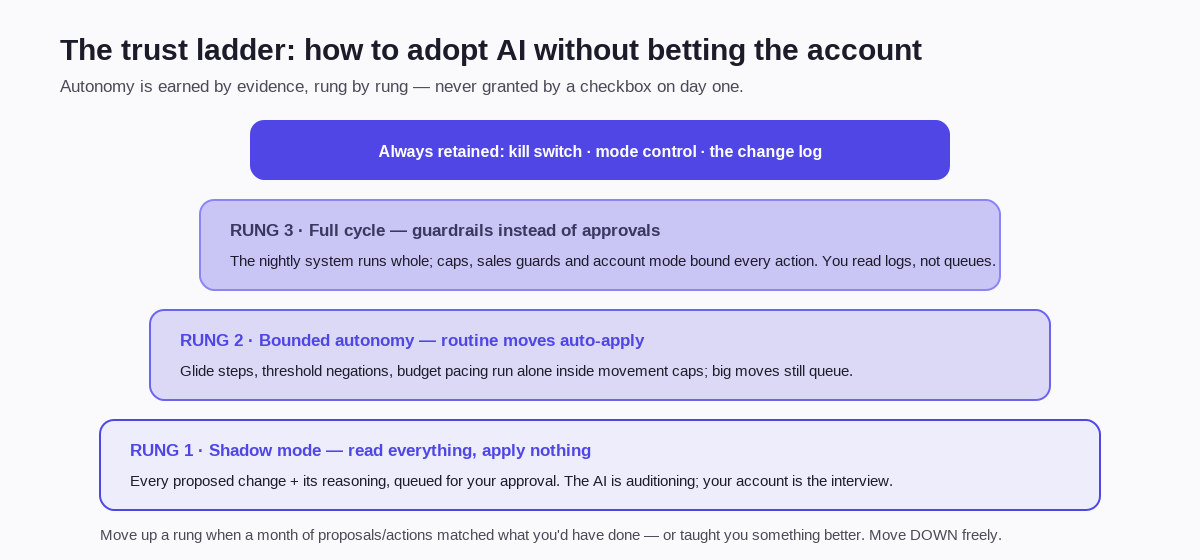
The ladder's logic: autonomy is a variable, not a decision. Rung 1 (shadow mode) costs nothing and teaches everything — a month of reading proposals-with-reasons against your own judgment is simultaneously an audit of the system and, for many sellers, the best PPC education available, because it's your account being reasoned about. Rung 2 releases the routine (glide steps, threshold negations, pacing) inside movement caps while big moves still queue. Rung 3 trades approvals for guardrails — caps, sales guards, account modes — and your role becomes reading logs and setting strategy.
Two properties make the ladder safe rather than ceremonial: descent is always free (any rung, any time, including a full stop), and the change log never goes away — full autonomy with full auditability is the end state, not blind trust. A system that resists either property is asking for faith; the ladder exists so you never have to extend any.
Amazon's own AI vs yours: the two-layer reality
A confusion worth untangling: Amazon itself runs AI all through the ad platform — dynamic bidding's conversion predictions, auto-campaign targeting, and increasingly format-level optimisation. Doesn't that make seller-side AI redundant?
No — because the two layers optimise for different principals. Amazon's AI optimises the marketplace: relevance, shopper experience, and (unavoidably) Amazon's revenue. It will happily spend your budget efficiently toward outcomes that are only loosely yours. Your layer's job is to be the counterparty: set the bids Amazon's dynamic systems modify, bound what its multipliers can do (the effective-bid audit), read its targeting suggestions as hypotheses to verify rather than gifts, and hold the line on your economics — margins Amazon doesn't know, break-evens it doesn't price, strategy it doesn't share. The seller-side AI question isn't "AI or not" — both layers already exist. It's whether your side of the table is played by a system or by whoever remembered to log in this week.
A buyer's checklist, compressed
Evaluating any AI advertising claim in ten minutes:
- "Show me yesterday's changes, with reasons." The one question that sorts the entire market.
- "What evidence, re-read how often?" Nightly re-derivation vs frozen rules.
- "Settled windows?" A system reacting to raw yesterdays is reacting to noise, confidently.
- "Movement caps and sales guards?" No bounds, no trust — whatever the model.
- "What happens in my first week?" Preview-first (the ladder's rung 1) vs immediate live changes.
- "Where are your boundaries?" Real systems name them (listings, strategy, demand); label-AI claims everything.
- "How does the fee scale?" Percentage-of-spend AI has the same incentive wedge as percentage-of-spend agencies.
(Yes, this doubles as our own spec — AIAdKing is built to pass exactly this checklist, and the automation explainer runs the longer version tool-agnostically.)
The honest bottom line
AI in Amazon advertising is neither the revolution the decks promise nor the vapor the cynics claim. It's narrower and better than both: the four jobs above, done every night with the discipline humans have but can't sustain — plus a paint industry that borrowed the word. The sellers winning with it aren't the ones who believed hardest; they're the ones who audited (the checklist), adopted on the ladder (shadow first), kept the boundaries human (strategy, listings, inputs), and let the machine own what machines own: cadence, arithmetic, and the memory of why every number is what it is.
AIAdKing's nightly cycle is our implementation of exactly that scope — every action logged with its reasoning, shadow mode as the default first rung, guardrails structural, flat fee outside the incentive wedge. The free trial is rung 1 on your real account: a month of watching the reasoning is the only AI evaluation that matters.