
What Rufus is, and what's actually known
Rufus is Amazon's generative shopping assistant, rolled out across the app and site: shoppers ask natural questions ("what should I look for in a trail camera?", "will this fit a Series 9?") and Rufus answers conversationally — drawing, per Amazon's own descriptions, on listing details, reviews, community Q&A and the broader web, with product recommendations (and yes, sponsored placements) woven in.
What's publicly known stops roughly there. What isn't known: the ranking function, the weighting of surfaces, how sponsored slots interleave, or any reliable way to measure "Rufus rank". Every guide claiming otherwise is extrapolating — including, inevitably, parts of this one, which is why its strategy deliberately avoids depending on unknowables. The bet this page makes is narrow and safe: an assistant can only answer from available content, so completeness and extractability of your content are the optimizable surface — a bet that pays even if Rufus vanished tomorrow, because the same surfaces feed A9's relevance, conversion, and every other AI shopping agent now reading Amazon.
The shift: from search terms to answerable claims
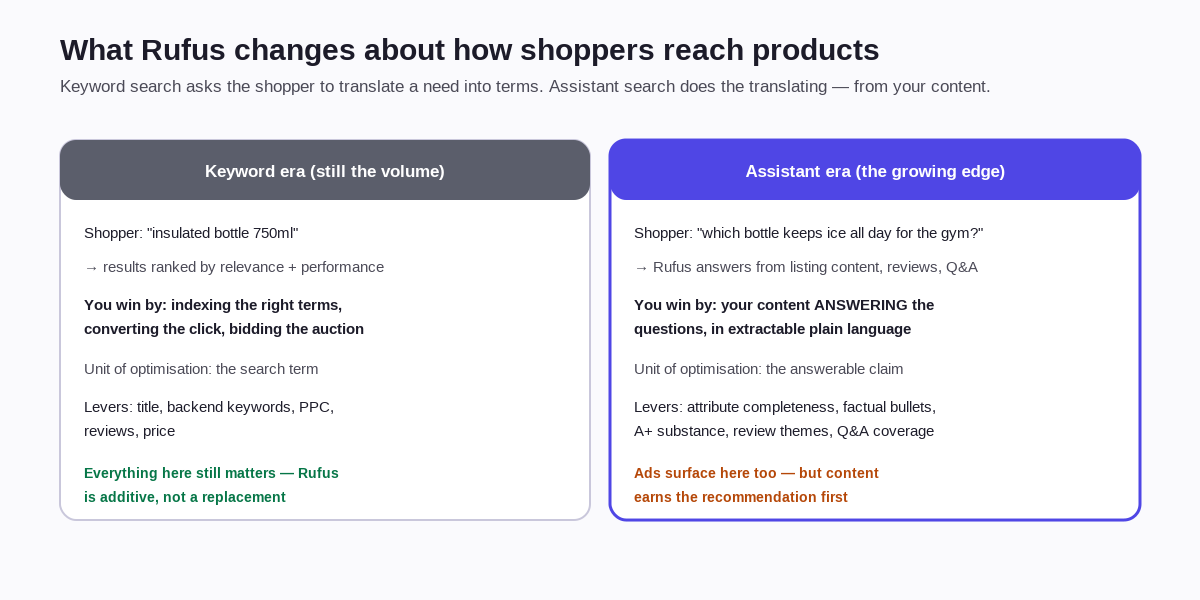
The structural change worth internalising: keyword search made the shopper translate a need into terms, and sellers optimized the translation's landing spots (indexing, titles, bids). Assistant search moves the translation into the machine — the shopper states the need ("keeps ice all day, fits a car cup holder, for the gym") and Rufus assembles an answer from whoever's content contains one.
That changes the unit of optimization from the search term to the answerable claim: a factual, extractable statement your content makes that maps to a question buyers actually ask. "Keeps ice 24 hours" is a claim. "Fits standard car cup holders (7.2cm base)" is a claim. "ULTIMATE hydration companion" is not — no question ends in it. Counting your listing's claims against the questions in your category is the whole audit, and the five-surface checklist below is where the claims live.
The five surfaces, audited
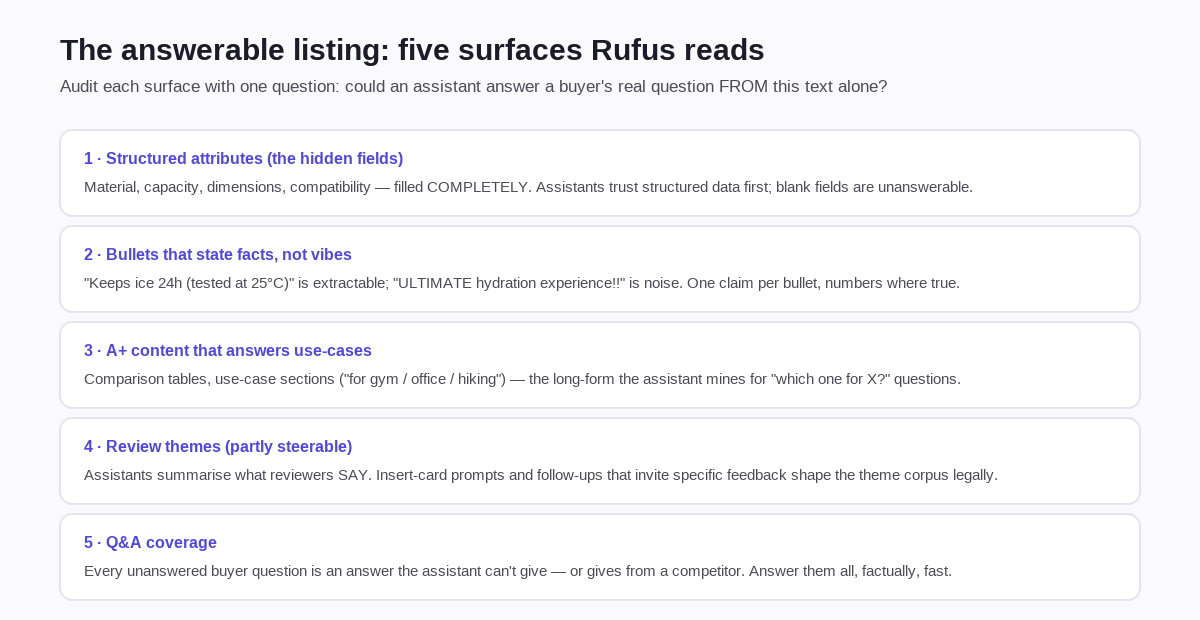
Priority notes beyond the chart:
- Attributes first, because they're binary. A blank capacity field is a question your product cannot be the answer to, at any rank. The hidden attribute sheets (dimensions, materials, compatibility, care) are the fastest completeness wins on Amazon, and the least glamorous — which is why competitors leave them blank too.
- Bullets: one claim each, numbers where true. The listing guide covers conversion copy; the assistant layer adds a constraint — every bullet should survive being quoted alone, out of context, as an answer. Hype adjectives don't survive quotation.
- A+ for the "which one for X?" class: comparison tables across your own range and explicit use-case sections give the assistant pre-assembled answers to segmentation questions — the questions where a recommendation is genuinely up for grabs.
- Q&A is the forgotten surface: it's literally a question-answer corpus sitting on your listing. Unanswered questions are open goals; answers written factually (not defensively) are assistant food.
Reviews: the surface you can only steer legally
Assistants summarise what reviewers say — "customers say it keeps drinks cold but the lid is hard to clean" is Rufus's bread and butter. That makes review themes an optimization surface, with a hard legal boundary: you cannot buy, script or filter reviews, and the compliant playbook is the only playbook.
What legal steering looks like:
- Volume through compliant asks: consistent Request-a-Review usage grows the corpus the assistant summarises — thin review bases produce thin, hedgy summaries.
- Theme-shaping through product truth: the lid that's hard to clean will dominate your summary until the lid changes. Review mining is product feedback with an SEO consequence now — the fastest "Rufus optimization" for many products is fixing the thing reviewers mention.
- Question-inviting follow-ups: insert cards and follow-ups that ask buyers to mention what they used it for (legal — you're not asking for positivity) enrich the use-case signal both assistants and future buyers read.
- Answering critical reviews where the platform allows seller responses adds context the assistant can weigh.
What happens to PPC in an assistant world
The ads question everyone asks, honestly answered:
- Keyword PPC keeps working, at volume. Assistant queries are a growing slice, not a replacement — the core loop and everything downstream of it remains the profit engine for the foreseeable horizon.
- Sponsored placements exist inside Rufus experiences, and Amazon will surely expand them — but targeting and reporting for assistant surfaces are (so far) folded into existing ad products rather than exposed as a separate lever. There is, today, no "Rufus bid" to optimize. Distrust anyone selling one.
- The conversion story tightens. An assistant that pre-answers questions sends better-qualified clicks — sellers with answerable listings should expect (and watch for) CVR firming on assistant-referred traffic, which feeds straight back into what their bids can afford.
- Search-term data gets a new accent: conversational fragments showing up in search-term reports ("bottle that fits cup holder") are early signals of question-shaped demand — harvest them as both keywords and content prompts.
The claims audit: a 45-minute workflow
The practical session, per hero product:
- Collect the questions (15 min): your listing's Q&A, competitor Q&As, review sentences ending in "?" or starting with "I wish I'd known", and your search-term report's conversational fragments. Cluster into 10-20 real buyer questions.
- Score the answerability (15 min): for each question, can your listing answer it — from which surface, in quotable form? Mark: answered / answered-but-buried / unanswerable. Competitor listings get the same pass; their gaps are your openings.
- Fix in surface order (15 min planning): blank attributes first (minutes each), bullet rewrites second (one claim per bullet), Q&A answers third, A+ additions last (the biggest lift, scheduled rather than done live).
- Re-run quarterly — questions drift with seasons and product changes, and the backend-keywords refresh is the natural sibling ritual: same session, adjacent surfaces.
Notice what the workflow never does: guess at Rufus's algorithm. Its output — a listing that answers its category's questions — is robust to every possible answer to the unknowables.
Beyond Rufus: the same work feeds every assistant
The strategic reason to do this now rather than when "Rufus SEO" matures: Rufus is one member of a class. Off-Amazon AI assistants increasingly answer shopping questions with Amazon links; browser and OS-level agents summarise product pages; comparison AIs read the same surfaces. Every one of them faces your listing with the same constraint — they can only work with what's there — and rewards the same properties: complete structured data, factual extractable claims, substantive long-form, a healthy review corpus, answered questions.
That's also the quiet defensive case. As assistant-mediated shopping grows, the gap between answerable and unanswerable listings compounds: assistants recommend from the former and simply never surface the latter, in an interface with no page two. The keyword era let a weak listing buy visibility with placement premiums; the assistant era increasingly doesn't sell that slot. Content completeness is becoming what indexing was in 2015 — table stakes that early movers get cheap.
Keeping the surfaces maintained
Like every optimization surface in this series, answerability decays: attributes blank out under bulk-feed overwrites, new buyer questions accumulate unanswered, review themes drift, and a listing edit that helped conversion can delete the claim an assistant was quoting. The maintenance loop is quarterly at minimum — and it's exactly the kind of completeness-checking that systems hold better than calendars.
AIAdKing's listing engine already audits the mechanical layer continuously — attribute completeness, content substance, suppression risks, byte-validated backend fields — and flags the gaps that make listings unanswerable, alongside the nightly ads cycle that harvests those conversational search-term fragments as they appear. Every flag with its reason, flat fee, official APIs only. The assistant era rewards exactly the sellers whose boring surfaces stay complete — which is a maintenance problem, and maintenance is what we automate.